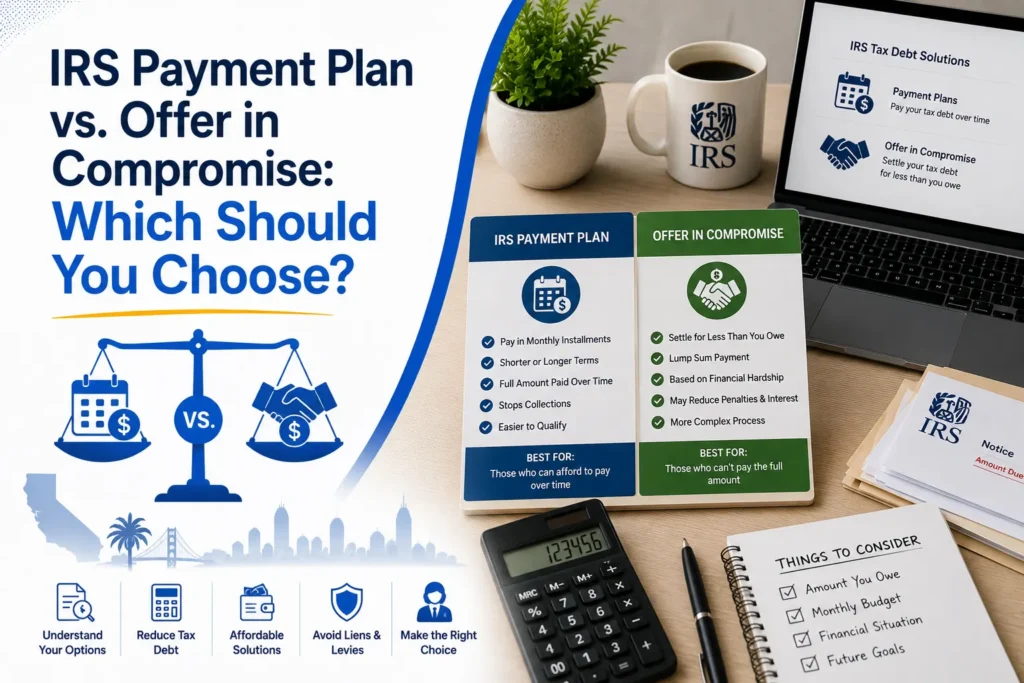
If you owe the IRS and cannot pay your full tax bill today, the two most common relief options are an IRS installment agreement and an Offer in Compromise (OIC). The right choice depends on your income, assets, monthly expenses, and your ability to pay the debt over time.
An installment agreement helps taxpayers who can pay over time. An Offer in Compromise is designed for taxpayers who cannot reasonably pay the full amount.
Key Takeaways
|
Understanding IRS Tax Resolution Options
IRS tax resolution means using an IRS-approved program to resolve unpaid federal taxes while meeting current tax obligations. The IRS offers several programs because taxpayers face different financial situations.
Before approving any resolution, the IRS reviews whether you can realistically pay your balance through available income or assets. In our experience, many taxpayers focus only on lowering their monthly payment. The better approach starts with understanding which program matches your overall financial condition.
Choosing the Right Resolution Based on Your Financial Situation
The best choice depends on what you can reasonably afford today and over the remaining collection period.
Consider these factors before selecting an IRS program:
- Your total tax balance.
- Your monthly disposable income after allowable expenses.
- Available cash in bank accounts.
- Equity in your home, vehicles, or investments.
- Whether your financial hardship is temporary or long-term.
- Whether you filed every required tax return.
- Whether you expect your income to increase soon.
| Example: Sarah owes $48,000 in federal taxes. She recently returned to full-time employment and has enough monthly income to make payments. Because she has the ability to repay over time, an installment agreement is likely a better option than an Offer in Compromise. |

What Is an IRS Installment Agreement?
An installment agreement is a payment arrangement that allows you to pay your tax debt through scheduled monthly payments instead of paying the entire balance immediately.
An installment agreement does not reduce the original tax debt. Interest and applicable penalties generally continue until the balance is paid in full. The IRS explains these payment options in Topic No. 202, Tax Payment Options. Hence, you must continue making payments and remain current with future tax filings and taxes.
Types of IRS Payment Plans
The IRS offers several payment arrangements depending on the amount owed and your financial circumstances.
| Payment option | Best suited for | Key point |
| Short-term payment plan | Taxpayers who can pay within the IRS’s short-term period | No monthly installment agreement fee may apply, but interest and penalties generally continue. |
| Long-term installment agreement | Taxpayers needing monthly payments | Monthly payments continue until the balance is fully paid or otherwise resolved. |
| Direct Debit Installment Agreement | Taxpayers wanting automatic payments | Payments are withdrawn automatically from a bank account, reducing missed payment risk. |
The table shows that the IRS provides several payment methods instead of one standard program. The correct option depends on how quickly you can repay the balance and whether automatic payments fit your budget.
Who Qualifies for an Installment Agreement?
You may request an installment agreement if you meet IRS eligibility requirements and remain compliant with current tax obligations.
Common qualification factors include:
- All required tax returns have been filed.
- The taxpayer agrees to remain current with future filing requirements.
- The taxpayer agrees to make scheduled monthly payments.
- Financial information may be required depending on the balance owed and agreement type.
- The IRS determines the proposed payment is acceptable.
Timely tax filing remains important even after the agreement begins. Missing future filing deadlines can place the agreement in default.
Pros and Cons of Monthly IRS Payments
A monthly payment plan works well for taxpayers who have a steady income but cannot pay their balance immediately. It may not be the best choice for taxpayers facing long-term financial hardship.
The table highlights that a payment plan improves cash flow today, but it usually increases the total amount paid over time because interest continues until the balance is fully satisfied.
| Advantages | Limitations |
| Stops the need for one large payment. | Interest generally continues until paid. |
| Helps maintain IRS compliance. | Penalties may continue where applicable. |
| Predictable monthly budgeting. | Missing payments can place the agreement in default. |
| Available for many taxpayers. | Total repayment may exceed the original tax due because of accrued interest and penalties. |
What Is an Offer in Compromise (OIC)?
An Offer in Compromise is an IRS program that allows eligible taxpayers to settle a tax debt for less than the full amount owed when paying the full liability is not reasonably possible.
An Offer in Compromise is not available simply because paying taxes feels difficult. The IRS carefully reviews each application using financial information, future income potential, and available assets before making a decision. This program is explained in the Offer in Compromise Booklet, Form 656-B. In our experience, the IRS focuses much more on your ability to pay than on the total amount you owe.
How an Offer in Compromise Works
The IRS reviews whether the amount offered equals or exceeds your reasonable collection potential. Reasonable collection potential is the IRS estimate of what it could collect through your available assets and future income.
A standard Offer in Compromise application generally includes:
- Form 656, Offer in Compromise.
- Form 433-A (OIC) for individuals or self-employed taxpayers.
- Form 433-B (OIC) for businesses.
- Required supporting financial documentation.
- Application fee unless an exception applies under IRS rules.
Your application will be delayed if supporting financial documents are incomplete.
Who Qualifies for an Offer in Compromise?
An Offer in Compromise qualification depends on your ability to pay, not simply how much tax you owe. The IRS generally will not accept an Offer in Compromise if it believes you can pay the full balance through an installment agreement or other collection methods.
The IRS reviews your complete financial picture before making a decision. The IRS generally expects applicants to:
- File all required federal tax returns.
- Receive a bill for at least one tax debt included in the offer.
- Make all required estimated tax payments if applicable.
- Stay out of an active bankruptcy proceeding.
- Employers must make required federal tax deposits before applying.
Reasonable Collection Potential (RCP) is the IRS estimate of how much it could realistically collect from your assets and future income. If your RCP equals or exceeds your tax debt, the IRS generally will not approve an Offer in Compromise.
Types of Offer in Compromise Programs
The IRS accepts Offers in Compromise under three legal grounds, which are explained in the table below. The table shows that an Offer in Compromise is not only for financial hardship. Different legal standards apply depending on why the taxpayer requests relief.
| Program | When it applies |
| Doubt as to Collectibility | You cannot reasonably pay the full tax debt. |
| Doubt as to Liability | There is a genuine dispute about the correct amount owed. Form 656-L is generally used instead of Form 656. |
| Effective Tax Administration | You legally owe the tax and could technically pay it, but collecting the full amount would create exceptional hardship or would be unfair. |
IRS Payment Plan vs Offer in Compromise: Key Differences
The biggest difference between an IRS payment plan vs offer in compromise is whether the IRS believes you can fully repay your tax debt. A payment plan assumes repayment over time, while an Offer in Compromise seeks to settle the liability for less than the full amount when the IRS determines full collection is unlikely.
The comparison below highlights factors many taxpayers overlook before choosing between these two IRS payment options.
| Factor | Installment Agreement | Offer in Compromise |
| Main goal | Pay the full balance over time | Settle for less when eligible |
| Financial review | May be required depending on the balance | Required for most applications |
| Required forms | Financial forms may be required | Form 656 plus Form 433-A (OIC) or Form 433-B (OIC) |
| IRS review | Reviews payment ability | Reviews Reasonable Collection Potential |
| Future compliance | Required | Required for five years after acceptance or the offer may default |
Eligibility Requirements
Eligibility differs because each program solves a different problem.
For an installment agreement:
- You generally must file all required returns.
- You must agree to make scheduled payments.
- You must remain current with future taxes.
For an Offer in Compromise:
- Complete financial disclosure is generally required.
- The IRS evaluates assets, income, expenses, and future earning ability.
- You must continue meeting future tax obligations if your offer is accepted.
Total Cost and Financial Impact
A payment plan usually results in paying the entire tax debt plus continuing interest and applicable penalties until paid.
An accepted Offer in Compromise can reduce the total amount paid. However, submitting an offer does not guarantee approval. The IRS accepts only offers meeting legal requirements.
Application Process and Required Forms
An Offer in Compromise generally requires:
- Form 656, Offer in Compromise.
- Form 433-A (OIC) or Form 433-B (OIC).
- Supporting financial documents.
- Required application fee unless an exception applies.
- Initial payment unless an exception applies.
One common mistake is submitting incomplete financial records. In our experience, incomplete documentation often delays IRS review more than the financial numbers themselves.
Approval Time and Success Factors
The IRS does not guarantee approval within a fixed timeline. Processing depends on application completeness, supporting documents, and case complexity.
One overlooked point is that taxpayers submitting a periodic payment Offer in Compromise generally must continue making proposed payments while the IRS reviews the application.
Which IRS Resolution Option Is Best for Your Situation?
A payment plan is usually the better option when:
- You have a stable monthly income.
- You can repay the balance over time.
- Your financial hardship is temporary.
- You want predictable monthly payments.
An Offer in Compromise may fit better when:
- Assets have limited value.
- Monthly disposable income is very low.
- Serious financial hardship exists.
- The IRS determines full collection is unlikely.
Situations Where Other IRS Relief Options May Apply
Some taxpayers qualify for different relief programs. These may include:
- Currently Not Collectible status.
- Penalty relief when IRS requirements are met.
- Appeal rights explained in Publication 5.
- Taxpayer Advocate Service assistance for qualifying hardship cases.
Common Mistakes Taxpayers Make When Choosing IRS Relief
Many taxpayers select the wrong solution because they focus only on reducing monthly payments instead of long-term compliance.
Common mistakes include:
- Applying for an Offer in Compromise before filing all required tax returns.
- Ignoring future timely tax filing requirements.
- Assuming every large tax debt qualifies for settlement.
- Underreporting assets or income.
- Missing requested IRS documents.
- Failing to understand IRS payment plan rules before signing an agreement.
- Ignoring future IRS compliance strategies causes agreements to default.
- Waiting until IRS collection actions become more serious before requesting IRS tax debt relief.
How Focus CPA Helps You Choose the Right IRS Resolution
Choosing between an installment agreement and an Offer in Compromise requires more than comparing monthly payments. It requires reviewing your financial records, IRS notices, and long-term compliance responsibilities.
At Focus CPA Group, our team helps clients by:
- Reviewing income, assets, expenses, and IRS collection history.
- Explaining whether an IRS installment agreement vs. OIC appears more appropriate.
- Preparing IRS financial disclosure forms.
- Helping organize supporting documentation.
- Communicating with the IRS throughout the resolution process.
- Building practical IRS compliance strategies after the case is resolved.
We review your financial information before recommending a strategy. That helps avoid pursuing an option that does not match IRS qualification standards. We also help clients understand what supporting records should accompany IRS forms.
Our team communicates directly with the IRS, responds to requests for information, and helps clients remain compliant throughout the resolution process.
If you need guidance choosing between IRS payment options, book a consultation. We will explain your available options in clear language and help you move toward a practical resolution.
Select the IRS Resolution Strategy That Fits Your Needs
Choosing between an IRS payment plan vs. an offer in compromise starts with understanding your true financial ability, not simply the amount of tax you owe. Taxpayers who can reasonably repay their balance often benefit from an installment agreement. Those facing genuine financial hardship may qualify for an Offer in Compromise if they satisfy IRS eligibility requirements.
At Focus CPA Group, our experienced tax professionals evaluate your circumstances, explain every available IRS relief option, and help you pursue the strategy that offers the best outcome. Whether you need a manageable payment plan or want to explore an Offer in Compromise, contact us today to guide you toward lasting tax resolution.
FAQs
An IRS payment plan vs. an Offer in Compromise differs because a payment plan repays the full tax debt over time, while an Offer in Compromise settles for less only if the IRS determines full collection is unlikely.
To qualify for an Offer in Compromise, you generally must file all required tax returns, stay out of bankruptcy, and prove through financial information that you cannot reasonably pay the full tax debt.
No. An IRS installment agreement vs OIC begins with filing all required tax returns, meeting applicable IRS payment plan rules, and agreeing to remain current on future tax obligations.
The best IRS resolution option depends on repayment ability, not debt size. Large balances alone do not qualify someone for IRS tax debt relief through an Offer in Compromise.
No. An accepted Offer in Compromise settles only the tax periods listed in Form 656 after you satisfy all payment terms and remain compliant with future tax obligations.
Yes. The IRS can reject your application if you fail to qualify for an Offer in Compromise, submit incomplete financial records, or offer less than your reasonable collection potential.
Most applicants submit Form 656 with Form 433-A (OIC) for individuals or Form 433-B (OIC) for businesses, plus required supporting financial documents.
No. Under most IRS payment options, interest and applicable penalties generally continue until the tax balance is fully paid, even while monthly payments remain current.
Yes. A qualified tax professional can compare an IRS payment plan vs. an Offer in Compromise, explain eligibility, prepare accurate IRS forms, and reduce costly filing mistakes before submission.
