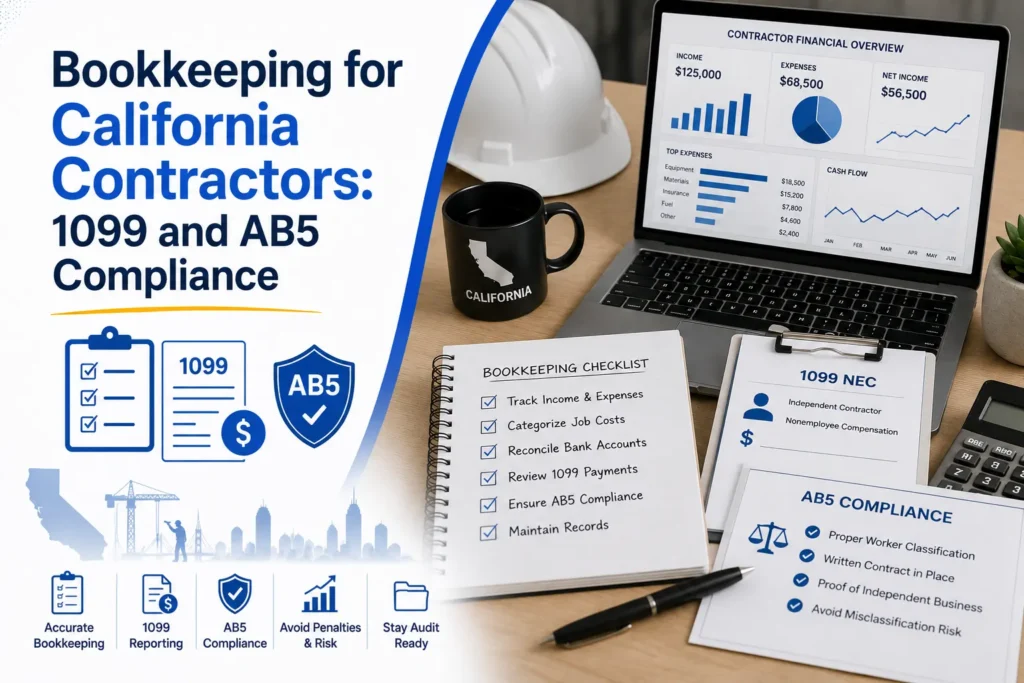
If you hire or work as an independent contractor in California, your bookkeeping has to do more than track dollars. It has to prove your worker classification holds up under state law. Bookkeeping for contractors in California under AB5 rules means your records need to show clean payment trails, correct 1099 filings, and documentation that supports how you classified each worker.
Key Takeaways
|
Why Accurate Bookkeeping Matters for California Contractors
Accurate books protect you from two separate risks at once: tax errors and worker misclassification claims. Every payment record, invoice, and contract you keep becomes evidence if the state or IRS ever questions how you classified a worker.
In our practice, we’ve seen contractors treat bookkeeping as a year-end chore instead of an ongoing compliance tool. That mindset creates gaps that surface at the worst possible time, usually during an audit.
Financial Challenges Contractors Face
Contractors juggle irregular income, self-employment tax, and expense tracking without an employer handling withholding for them. Cash flow swings between projects, which makes it hard to set aside enough for quarterly estimated payments.
Many contractors also mix personal and business spending in one bank account, which is the fastest way to lose deductions and confuse business accounting vs. personal accounting during tax season.
Common Bookkeeping Mistakes That Create Tax Problems
The most damaging bookkeeping mistakes compound over a full tax year. A missed reconciliation in March becomes a mismatched 1099 total in January.
- Paying contractors through personal Venmo or Zelle instead of a business account, which breaks the paper trail auditors expect to see
- Skipping W-9 collection before the first payment, which forces a scramble for taxpayer ID numbers at filing time (a Los Angeles marketing agency we reviewed had to delay three 1099-NEC filings because of this)
- Recording contractor payments as “miscellaneous expense” instead of a dedicated ledger account, which hides how much one worker actually received
- Never comparing contract terms to actual working conditions, so the paperwork says “independent contractor” while daily practice looks like employment

Understanding California AB5 and Worker Classification
California AB5 is a state law that requires most businesses to treat workers as employees unless the business proves the worker meets all three parts of the ABC test. It moved California away from the older, more flexible standard and toward a system that assumes employment by default.
What Is the California AB5 Law? What’s the ABC Test?
The ABC test is the legal standard California uses to decide whether a worker is an employee or a contractor. Under the California Department of Industrial Relations, a hiring business must prove all three conditions, or the worker is legally an employee, no matter what the contract says.
- Part A: The worker is free from the hiring company’s control and direction, both by contract and in actual daily practice
- Part B: The worker performs work outside the hiring company’s usual line of business (a plumber fixing a leak at a retail store passes this test; a seamstress sewing garments for a clothing company does not)
- Part C: The worker is already running an independent trade or business of the same kind as the work performed
AB5 compliance bookkeeping starts here, because your books need to reflect the actual working relationship. Paying someone through Form 1099 does not make them a contractor under state law.
Businesses That May Qualify for AB5 Exemptions
Certain professions and business-to-business relationships skip the ABC test and use the older Borello multi-factor test instead. Licensed accountants, attorneys, physicians, freelance writers, graphic designers, and marketing consultants fall under specific carve-outs, but each exemption comes with its own conditions attached.
The bona fide business-to-business exception is the one most small companies try to use, and it has thirteen separate requirements, including a written contract, a separate business location, and the contractor’s own business license.
1099 vs W-2: Why Proper Classification Matters
Classification determines who pays payroll taxes, who gets overtime protection, and who bears the risk if the IRS or California disagrees with your call. Getting a 1099 or W2 California classification wrong can trigger audits from three different agencies at once.
Key Differences Between Independent Contractors and Employees
A W-2 employee works under your direction, uses your equipment, and has taxes withheld from every paycheck. A 1099 contractor sets their own schedule, uses their own tools, and pays self-employment tax on the full amount they earn.
The table below breaks down how contractor classification bookkeeping should treat each category differently across taxes, control, and benefits.
| Factor | 1099 Independent Contractor | W-2 Employee |
| Tax withholding | None; contractor pays own tax | Employer withholds federal, state, FICA |
| Control over work | Sets own hours and methods | Employer directs schedule and process |
| Tools and equipment | Contractor supplies their own | Employer typically provides |
| Benefits | None required | Workers’ comp, unemployment insurance apply |
| Reporting form | Form 1099-NEC | Form W-2 |
| Misclassification risk | Employer liable if control exists | N/A |
Payroll vs Contractor Payments
Payroll payments run through a formal system with tax withholding, while contractor payments are gross amounts with no deductions taken out. This difference changes how your books should record each transaction from day one.
| Category | Payroll Payments | Contractor Payments |
| Bookkeeping entry | Wage expense + payroll tax liability | Contractor expense, single line item |
| Frequency tracking | Pay period based | Invoice or milestone based |
| Required forms | W-4, W-2, DE 9C | W-9, 1099-NEC |
| Tax deposits | Federal and state deposits required | None owed by hiring business |
Financial Risks of Worker Misclassification
Misclassification penalties in California start at $5,000 and climb to $25,000 per willful violation under Labor Code Section 226.8. On top of that penalty, you can owe back payroll taxes, unpaid overtime, missed meal and rest break premiums, and interest going back years.
The Employment Development Department can add a separate penalty equal to 15% of the tax deficiency if it finds the misclassification was negligent or intentional. Multiply that across ten misclassified workers, and a small compliance gap turns into a business-threatening bill.
Bookkeeping Best Practices for California Contractors
Strong bookkeeping practices catch classification and tax problems months before a filing deadline forces the issue. California payroll compliance bookkeeping checklist items work best when they run on a set monthly schedule instead of a once-a-year scramble.
- Separate every contractor payment into its own ledger account by worker, so year-end 1099 totals match your bank records exactly
- Collect a signed W-9 before the first payment, not after; this alone prevents most year-end filing delays
- Reconcile bank and credit card accounts every month, not quarterly, since errors compound the longer they sit unresolved
- Document the actual working relationship with dated notes on scheduling, tools, and instructions given, which matters more than the contract wording if the state ever asks
- Track 1099 payment totals in real time using accounting software instead of adding it up in December
In our practice at Focus CPA, we set up a running contractor payment tracker for every client that pays 1099 workers. A landscaping company caught a $6,200 duplicate payment in October simply because the running total looked off compared to prior months.
Managing 1099 Reporting and Tax Compliance
Proper 1099 reporting means matching every contractor payment to a valid W-9, filing on time, and keeping records that would survive an IRS or FTB review. Federal and California requirements run on parallel tracks, and missing either one carries separate penalties.
Preparing Accurate 1099 Records
Accurate 1099 records start with a valid taxpayer ID number and a payment total that matches your books, not your memory. The IRS requires businesses to collect Form W-9 from every contractor before the first payment goes out.
Under the current IRS reporting rules, businesses must issue Form 1099-NEC once nonemployee compensation reaches $2,000 for payments made in 2026, up from the long-standing $600 threshold. That threshold applies per contractor, per calendar year, and it will adjust for inflation starting in 2027.
Tracking Contractor Payments Throughout the Year
Track every contractor payment the same month it happens, using a dedicated column or account per worker. Waiting until January to reconstruct a year of Venmo transfers and cash payments is where most 1099 errors begin.
Monthly bookkeeping tasks for California businesses should include a contractor payment review alongside your regular reconciliation. This single habit prevents the scramble that leads to inaccurate 1099 totals and late corrections.
Meeting Federal and California Reporting Deadlines
Form 1099-NEC is due to both the contractor and the IRS by January 31 each year, with no extension available for the recipient copy. California generally follows the federal 1099 reporting timeline but layers on its own quarterly estimated tax schedule.
California’s estimated tax payments run on a 30/40/0/30 schedule: 30% due April 15, 40% due mid-June, 0% due in September, and the final 30% due January 15. That uneven schedule catches many self-employed contractors off guard, since it does not match the IRS’s four equal quarterly payments.
How Professional Bookkeeping Supports AB5 Compliance
Professional bookkeeping supports AB5 compliance by creating a documented record that matches how you actually treat each worker. That paper trail becomes your strongest defense if the Labor Commissioner, EDD, or a worker files a misclassification claim.
- Maintain separate records for hours, deliverables, and instructions given to each contractor, since Part A of the ABC test hinges on actual control, not contract language
- Flag contractors performing core business functions for review, since Part B of the ABC test fails automatically when the work matches your usual business
- Verify each contractor’s independent business status with a business license, other clients, and their own marketing, which supports Part C
- Review classifications annually, not just at hiring, since a contractor’s role can drift toward employment over time without anyone noticing
Why California Contractors Choose Focus CPA Group
We built Focus CPA Group for contractors and small businesses that need California bookkeeping services built for AB5 and 1099 compliance. Our team has spent more than two decades working inside California’s specific tax and labor rules, which means we catch classification risks that a general bookkeeper might miss entirely.
- We separate every contractor payment into audit-ready records that match your W-9s, 1099 totals, and actual working relationship
- We track federal and California deadlines together, so a missed EDD filing never catches you off guard
- We flag classification red flags during routine bookkeeping instead of waiting for a state audit to find them
- We offer remote, real-time access to your books, so you always know where your numbers stand
Industry-Specific Bookkeeping Expertise
Our team handles bookkeeping services for small businesses in California across construction, real estate, consulting, and professional services, industries where AB5 exposure runs highest. We understand how each industry’s contractor relationships typically look, which sharpens our classification review.
Our clients get monthly bookkeeping tasks for California businesses built into their service plan, so classification and reporting issues surface early instead of at filing deadlines.
Scalable Accounting Solutions for Growing Contractors
As your contractor roster grows, so does your misclassification exposure. We scale your bookkeeping services alongside your business, adding QuickBooks support, CFO-level reporting, and tax planning as your needs expand.
If you want to get your contractor bookkeeping and AB5 compliance in order, book a consultation with Focus CPA Group, and we’ll review your current setup before problems find you first.
Stay Compliant with Better Contractor Bookkeeping
Bookkeeping for contractors’ California AB5 compliance depends on records that reflect real working relationships, not just contract labels. The ABC test, the new $2,000 federal 1099-NEC threshold, and California’s front-loaded estimated tax schedule all demand documentation that holds up under scrutiny.
Focus CPA Group is the choice for California contractors who need bookkeeping built specifically around AB5 and 1099 requirements. We combine two decades of California tax experience with hands-on, monthly attention to your books, so classification risks and filing deadlines never slip through. Contact us today to get California bookkeeping services built for contractors.
FAQs
AB5 is California's law requiring the ABC test to classify workers. It presumes contractors are employees unless the hiring business proves all three test conditions.
Bookkeeping tracks self-employment income, supports accurate 1099 filings, and creates the payment records needed to defend worker classification if challenged.
A 1099 contractor pays their own taxes and controls their work methods. A W-2 employee has taxes withheld and works under employer direction.
Bookkeeping documents actual working conditions like scheduling, tools, and control, which is exactly what the ABC test examines during a classification dispute.
Keep signed W-9s, contracts, invoices, payment records by worker, and notes on scheduling and control for at least four years.
Yes. Mixed payment records and missing contracts make it harder to prove ABC test compliance, raising audit and penalty exposure significantly.
Monthly. Waiting until tax season to reconcile a full year of transactions multiplies errors and missed deductions.
Not always, but any contractor paying multiple 1099 workers benefits from professional bookkeeping to manage AB5 risk and filing deadlines.
Focus CPA Group combines two decades of California tax experience with monthly bookkeeping built specifically around AB5 and 1099 compliance requirements.
