A California sales tax bookkeeping cleanup assessment checks whether your sales, taxable and nontaxable transactions, collected tax, district tax, purchases, exemptions, and filed CDTFA returns actually match up, then flags exactly what needs correcting. Focus CPA Group built this sales tax bookkeeping cleanup California service to confirm whether your records prove the sales tax liability you reported to CDTFA. If you cannot answer that with confidence, an assessment gives you a clear answer.
Key Takeaways
- CDTFA requires records detailed enough to show the date of a sale, what was sold, taxable versus nontaxable charges, and the tax applied.
- Sales and use tax records must be kept for at least four years unless CDTFA authorizes earlier destruction.
- If a previously filed return is wrong, CDTFA expects an amended return with any additional tax paid, plus interest.
- A refund claim must state the specific reason for the overpayment, the exact amount, and the reporting period involved.
- Bad debts, returned merchandise, and cash discounts on taxable sales are reported through CDTFA’s Schedule Q, not buried inside a regular return.
- A cleanup assessment should end with a written, period-by-period correction roadmap, not just a matched balance.
What Does a California Sales Tax Bookkeeping Cleanup Assessment Actually Check?
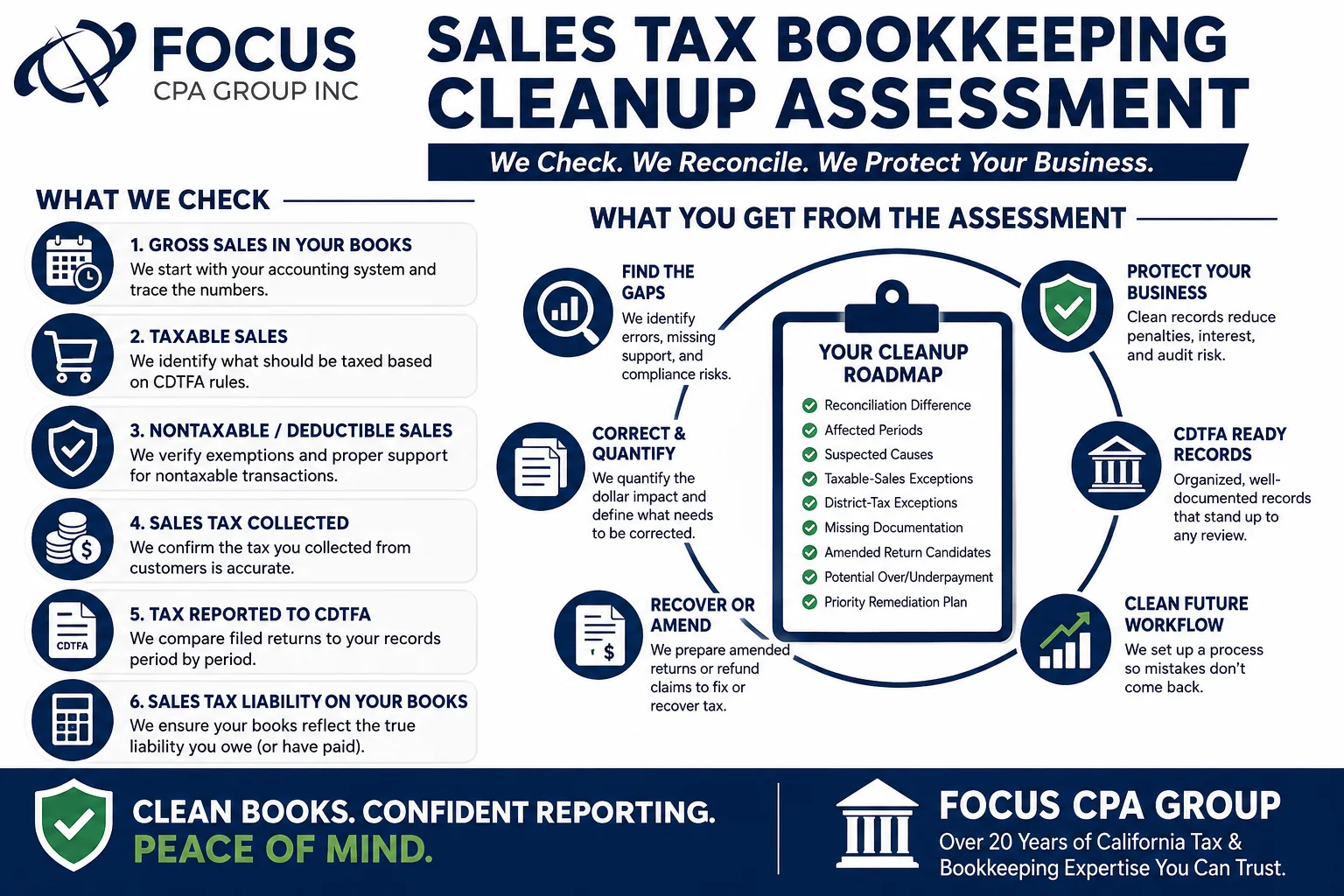
A California sales tax bookkeeping cleanup assessment is a reconciliation and evidence review, not a quick fix inside QuickBooks. It traces your numbers through six layers: gross sales in the accounting system, taxable sales, nontaxable or deductible sales, sales tax collected, sales and use tax reported to CDTFA, and the sales tax liability still sitting on your books.
At Focus CPA Firm, we don’t call a cleanup finished just because your accounting balance matches your tax return balance. The transactions behind that number, and the paperwork proving them, have to hold up too.
CDTFA’s own guidance on sales and use tax records states that its representatives must be able to determine the date of each sale, what was sold, the taxable and nontaxable portions, and the tax amount applied. A balanced spreadsheet that can’t answer those four questions is not a clean set of books.
What the Assessment Should Produce
A finished assessment hands you a working document. It should include:
The reconciliation difference, in dollars, by period
Affected reporting periods
The suspected cause of each variance
Taxable-sales exceptions
District-tax exceptions
Missing documentation, listed by transaction
Amended-return candidates
Potential overpayment or underpayment, quantified
A priority remediation list, ranked by dollar exposure
The Risks of Ignoring Cleanup
CDTFA can use standard accounting methods to estimate your liability if your records are found inadequate during an audit, and that estimate rarely favors the business.
Incomplete or inaccurate records may be treated as evidence of negligence, which opens the door to penalties.
Interest keeps accruing on unpaid tax the longer an error goes uncorrected.
Refund windows close. Overpayments from years ago may no longer be recoverable once the claim deadline passes.
Exemption and resale certificates that go missing turn nontaxable sales into taxable ones during an audit.
| Book an assessment if:Your accounting sales don’t match your CDTFA returns.Sales tax payable has been carried forward incorrectly month after month.You run multiple sales channels or POS systems that don’t talk to each other.You can’t produce transaction-level support for what you reported.District tax treatment on your sales is uncertain.You suspect missed taxable sales or, just as likely, overreported tax.Prior returns may need amendment.A CDTFA audit is pending, or you think one could happen. |
Signs Your Business Needs a Bookkeeping Cleanup
Your bank balance in QuickBooks doesn’t match your actual bank statement.
Sales tax payable shows a balance that never resolves, month after month.
You have unreconciled transactions going back more than one quarter.
Different POS systems or sales channels report different total sales figures.
Your bookkeeper and your CDTFA return were prepared by two people who never compared notes.
You’ve received a CDTFA notice, inquiry, or audit letter.
You’re planning to sell the business and need clean books for due diligence.
What Does a California Sales Tax Bookkeeping Cleanup Service Deliver After the Assessment?
A real cleanup service turns the assessment into a defined, four-part process with a specific purpose, and each one builds on the last so nothing gets patched over without an explanation.
Deliverable 1: Sales-Tax Reconciliation Report
This report lines up your books, your original sales data, and your filed CDTFA returns side by side, then explains every variance in plain language instead of leaving you to guess what changed.
Deliverable 2: Exception Report
Exceptions get sorted into categories: taxable-sales errors, nontaxable-sales support gaps, district-tax errors, use-tax issues, return-entry mistakes, missing documentation, and timing differences between when a sale happened and when it was recorded.
Deliverable 3: Correction Roadmap
For every issue found, the roadmap lays out the period, the issue, the tax impact in dollars, the documentation still needed, the correction required, and a priority ranking so the highest-risk items get fixed first.
Deliverable 4: Clean Future Workflow
Fixing history is only half the job. The roadmap should set up a repeatable monthly or quarterly account reconciliation process so the same mistake doesn’t resurface next quarter.
Our California Sales Tax Bookkeeping Cleanup Process
At Focus CPA Group, our California bookkeeping cleanup services follow a fixed sequence built from years of untangling California sales tax records for small and midsized businesses.
Initial Bookkeeping Assessment
We start with a full read of your current books against your filed CDTFA returns to size up how far off the numbers actually are before any correction work begins.
Transaction Review and Recategorization
Every sale and purchase gets reviewed for correct tax treatment. Miscoded taxable sales, missing exemption support, and incorrectly recorded use tax all get flagged and fixed at the transaction level.
Bank and Credit Card Reconciliation
We match every bank and card transaction against your books to close out bank balance discrepancies that often hide unrecorded sales or duplicate entries.
Sales Tax Account Review
Your sales tax payable account gets audited line by line to confirm it reflects what you actually owe or have already remitted, not a number that’s been carried forward by habit.
Financial Statement Verification
Once transactions are corrected, we verify that your income statement and balance sheet reflect the cleanup so your financial reporting and your CDTFA filings finally tell the same story.
In our practice, we’ve found that businesses running multiple sales channels are the ones most likely to have district tax errors buried in their books, simply because each channel calculates tax differently. If any of this sounds familiar, book a consultation with Focus CPA Group, and we’ll walk through your specific situation.
Cleanup vs Catch-Up Bookkeeping vs Ongoing Bookkeeping
The table below breaks down what cleanup, catch-up bookkeeping or ongoing bookkeeping actually covers, so you know exactly what to ask for.
| Service | What It Fixes | Typical Trigger | Time Frame |
| Cleanup Bookkeeping | Errors, miscoded transactions, unreconciled accounts in existing records | Books are inaccurate or don’t match tax filings | Past periods, usually 1 to 4 years |
| Catch-Up Bookkeeping | Missing entries from periods where no bookkeeping was done at all | Books were never kept current | Gap periods with no records |
| Ongoing Bookkeeping | Monthly recording, reconciliation, and reporting | Business needs current, reliable books going forward | Every month, indefinitely |
The table above shows that cleanup corrects incorrect numbers, catch-up fills in missing numbers, and ongoing DIY or professional bookkeeping keeps new numbers accurate from day one. Most businesses that need a bookkeeping fix for CA sales tax actually need cleanup first, followed by ongoing service so the same problems don’t return.
What Records Are Needed for a California Sales Tax Bookkeeping Cleanup Assessment?
A complete assessment needs source documents, not just account totals. Bring:
POS system reports and register tapes for each sales channel
Sales invoices and receipts
Resale and exemption certificates for nontaxable sales
Bank and credit card statements
Every CDTFA return filed for the periods under review
Purchase invoices and vendor bills
General ledger exports
Credit memos for returns, discounts, or bad debts
The IRS recordkeeping guidance in Publication 583 applies when your books need supporting documents like invoices and receipts behind every entry, not just journal totals. CDTFA applies that same standard to California sales and use tax.
How Far Back Should a California Sales Tax Bookkeeping Cleanup Review Go?
Most assessments cover four years, matching CDTFA’s minimum record retention requirement for sales and use tax. If an audit is already open, the review needs to cover the full audit period regardless of the four-year rule, and records should be kept until the audit and any related appeal are fully resolved. Refund claims run on a separate, shorter clock, so a cleanup that turns up an overpayment from five years ago may already be outside the window to recover it.
What Should Happen When the Cleanup Finds an Underpayment, Overpayment, or Filing Error?
This is the solution stage, and it deserves as much attention as finding the problem in the first place.
If the Cleanup Finds Tax Was Underreported
Identify the error, quantify it, determine which periods it touched, prepare the correction, calculate any interest that applies, then file an amended return and preserve the workpapers that support it. CDTFA states plainly that once a taxpayer finds an error on a previously filed return, the right move is to file an amended return and pay any additional tax due, including applicable interest.
If the Cleanup Finds Tax Was Overpaid
Finding an overpayment isn’t the finish line. The work still needs to establish why the overpayment happened, which period it affects, the exact amount, the state, local, and district tax breakdown, and whether an amended return or a formal refund claim is the right path. CDTFA’s refund guidance is your claim has to state the exact reason you overpaid, the amount, and the reporting period, or it won’t get processed.
If the Problem Is Caused by Returns, Bad Debts, or Discounts
These need their own adjustment tests rather than a generic correction. CDTFA’s return instructions address bad debt losses on taxable sales, returned taxable merchandise, and cash discounts on taxable sales as distinct tax recovery categories, each reported through its own schedule rather than folded into a general adjustment line.
Why Choose Focus CPA for Bookkeeping Cleanup?
Focus CPA Group has spent more than two decades working with California small and midsized businesses on accounting, bookkeeping, and CDTFA compliance bookkeeping service work, and that depth shows up in how cleanup engagements get handled.
California Tax Expertise
Our team focuses specifically on California state and local tax, including sales and use tax, so district tax rules and CDTFA procedures aren’t a side specialty; they’re the core of what we do daily.
QuickBooks Specialists
QuickBooks cleanup California work is a regular part of our bookkeeping practice, covering setup, transaction correction, and ongoing maintenance so your software actually reflects your real financial position.
Customized Cleanup Plans
No two businesses have the same mix of sales channels or transaction volume, so every cleanup plan we build gets scoped to your actual records instead of a generic checklist.
Ongoing Compliance Support
Once your books are clean, we stay involved with monthly or quarterly reconciliation so small errors get caught before they compound into a bigger problem.
If you’ve been putting off a bookkeeping fix, book a consultation with Focus CPA Group and get a straight answer about where your books actually stand.
Book Your California Bookkeeping Assessment
We pull your books, your original sales data, and your filed CDTFA returns, then walk through each reporting period to identify variances, missing documentation, and any district tax issues before recommending next steps.
What You’ll Receive
You’ll get a written summary of what we found, a dollar estimate of any exposure or overpayment, and a prioritized plan for correction, so you know exactly what needs fixing and in what order before any work begins.
Our bookkeeping services team at Focus CPA Group handles this from start to finish, and our state and local tax services group steps in directly for any CDTFA-facing correction work. Schedule your assessment today and get a clear picture of where your books stand.
Conclusion
A sales tax bookkeeping cleanup California service exists to check that your books actually support what you’ve reported to CDTFA. Getting that answer right protects you from penalties, recovers money you may have overpaid, and gives you records that hold up if CDTFA ever asks questions. The businesses that treat this as routine maintenance are the ones that stay audit-ready year-round.
Focus CPA Group brings over two decades of California tax and bookkeeping experience directly to this problem. We trace every sales tax dollar back to its source and build a process so the same errors don’t come back. We reconcile your books against your actual CDTFA filings line by line, then hand you a written correction plan with real numbers attached.
Contact us to book your assessment to clean books, protect your business today and your peace of mind at tax time.
FAQs
What is sales tax bookkeeping cleanup?
It’s a reconciliation service that compares your accounting records against your filed CDTFA sales tax returns and corrects any mismatches, missing support, or misclassified transactions.
Why is CDTFA compliance important for California businesses?
Yes, it’s essential. Inaccurate records can trigger penalties, interest, and estimated liability during an audit, since CDTFA can use standard accounting methods when records are inadequate.
How do I know if my books need cleanup?
Unreconciled bank balances, a sales tax payable account that never resolves, or numbers that don’t match your CDTFA returns are the three clearest signs.
Can you fix QuickBooks sales tax errors?
Yes. QuickBooks bookkeeping services at Focus CPA Group include correcting miscoded sales tax transactions, fixing sales tax liability accounts, and rebuilding accurate reporting inside your existing file.
What’s the difference between cleanup and catch-up bookkeeping?
Cleanup fixes existing but inaccurate records. Catch-up bookkeeping fills in periods where no bookkeeping happened at all. Most businesses need one or the other, not both.
How long does bookkeeping cleanup take?
Timeframes depend on transaction volume and how many periods need review, typically ranging from two to six weeks for most small businesses.
Will bookkeeping cleanup help with a CDTFA audit?
Yes. Clean, documented records are exactly what auditors need to verify your reported liability, which reduces the risk of an estimated assessment.
Do you provide ongoing bookkeeping after cleanup?
Yes. We offer outsourced bookkeeping services on a monthly or quarterly basis so corrected books stay accurate going forward instead of drifting again.
What documents are needed for a bookkeeping assessment?
POS reports, sales invoices, exemption certificates, bank statements, prior CDTFA returns, and purchase records form the core document set for any assessment.
Why should I choose Focus CPA for bookkeeping cleanup?
Focus CPA Group combines over two decades of California tax expertise with hands-on bookkeeping services in California, giving you both the correction work and the compliance knowledge behind it.
