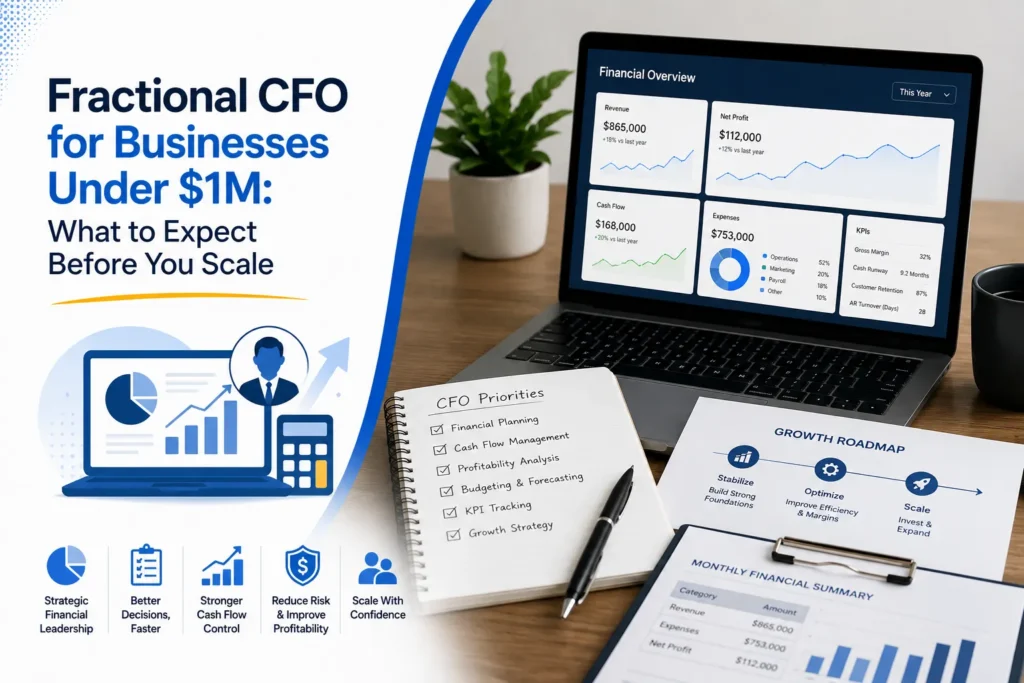
A business does not need a CFO because it crossed a specific revenue line. The $1 million mark is a useful editorial reference point, but the real trigger is financial complexity: cash that is harder to predict, hiring decisions that outpace the owner’s confidence, margins that are thinning without an obvious cause, or growth that is starting to strain working capital.
A bookkeeper records what already happened in the business. A CPA or tax professional confirms that those records are accurate and compliant. A fractional CFO, sometimes called a fractional CFO or CFO consultant, uses that same financial information to help ownership decide what should happen next, whether that means hiring, pricing changes, financing, or holding off on growth altogether.
Key Takeaways
|
Does a Business Under $1M Actually Need a Fractional CFO?
Revenue by itself tells you almost nothing about whether a business needs CFO-level planning. A company earning $700,000 with volatile customer concentration can need more financial oversight than a stable $1.2 million business with predictable contracts.
The Financial Signals That Matter More Than $1m in Revenue
These are the practical signs your business needs CFO expertise, based on financial behavior rather than a dollar threshold:
- Cash is becoming harder to predict from month to month.
- Growth is consuming cash faster than the business is generating it.
- The owner cannot confidently answer “what can we afford to spend this quarter?”
- Hiring, pricing, or expansion decisions increasingly depend on financial modeling rather than gut instinct.
- The business needs lender or investor-ready financial information.
- Multiple revenue streams or locations make it hard to see which parts of the business are actually profitable.
- The owner is the only person who understands how the numbers connect, creating a single point of failure.
- Pricing has not been reviewed against actual cost data in over a year.
If an owner is repeatedly making six-figure decisions using only backward-looking profit and loss reports and a bank balance, CFO-level planning can be justified well below $1 million in revenue.

What a Fractional CFO Should Do Differently From a Bookkeeper or CPA Before You Scale
Fractional CFO services typically start where bookkeeping ends. This work includes rolling cash flow forecasting, scenario modeling, budgeting, pricing and margin analysis, hiring affordability analysis, growth planning, financing strategy, KPI design, management reporting, and identifying financial constraints on growth.
A fractional CFO does not usually replace the bookkeeper or CPA. The IRS states that accurate books and supporting records are necessary for preparing financial statements, filing tax returns, and substantiating deductions (IRS Publication 583, Starting a Business and Keeping Records). CFO-level analysis is only as reliable as the bookkeeping underneath it.
| Role | Primary Question |
| Bookkeeper | What happened financially? |
| CPA or accountant | Is it recorded and reported correctly, and what tax issues need attention? |
| Fractional CFO | What should management do next, financially? |
What Should a Fractional CFO Check First in a Business Under $1M?
Start with the three financial statements. The U.S. Small Business Administration identifies the income statement, balance sheet, and cash flow statement as the core tools for understanding profitability, financial position, and available cash.
- A profit and loss statement shows whether the business made money.
- A balance sheet shows what it owns and owes at a point in time.
- A cash flow statement shows whether money actually moved when it needed to.
Then Investigate The Numbers Behind The Numbers
A thorough review goes past the three statements into:
- Accounts receivable aging and accounts payable timing
- Recurring versus one-time costs
- Gross margin and, where relevant, contribution margin
- Payroll burden as a share of revenue
- Customer concentration
- Inventory requirements and debt obligations
- Owner compensation and draws
- Upcoming tax obligations and working capital requirements
Check Whether The Accounting Data Can Actually Support Decisions
A sophisticated forecast is only as useful as the records feeding it. The IRS states that business records should clearly show income and expenses, and that supporting documents such as invoices and receipts should substantiate the transactions behind them. Before modeling growth, a fractional CFO should reconcile the historical numbers well enough to know which figures are reliable and which need cleanup first.
How a Fractional CFO Determines Whether Growth Will Create Cash or Consume It
More customers don’t automatically mean more available cash because growth adds costs and working capital needs before the related revenue is collected.
The “Profitable But Cash-Starved” Scenario
Consider a business where revenue rises, and gross profit rises with it. Payroll and inventory increase to support the new volume. Customers pay on 30 to 60-day terms. Cash leaves the business to cover payroll and suppliers well before receivables arrive. The result is that growth can increase a company’s financing needs even while its accounting profit improves.
The SBA notes that different accounting methods produce different views of cash and financial performance, which is exactly why cash visibility should never be confused with accrual-based profit. A fractional CFO models additional sales, additional costs, working capital, collection timing, and the resulting cash position, so the owner knows in advance whether the business can actually fund the growth it is planning.
What Financial Forecast Should a Business Under $1M Have Before It Scales?
A usable forecast does more than project twelve months of revenue. It should answer specific management questions. The forecast should answer these questions
- How much cash will the business have each month?
- When does cash become constrained?
- What happens if sales land 20% below plan?
- What happens if hiring starts three months earlier than expected?
- How much additional working capital will growth require?
- How long can the company operate if expected collections are delayed?
A forecast should include, at minimum, a base case, a downside case, and a growth case. A forecast used only as a static spreadsheet, never revisited against actual results, provides little more value than the bank balance an owner was already watching.
What Should a Fractional CFO Accomplish in the First 30, 60 and 90 Days?
These are reasonable deliverables to expect from an engagement, not an industry-wide requirement.
- Days 1 to 30, establishing financial truth: a review of the accounting data, current cash position, financial statements, working capital, and debt obligations, along with a list of key financial risks and reporting gaps.
- Days 31 to 60, turning historical data into decision tools: a rolling cash forecast, a working budget, a KPI dashboard, margin analysis, and an initial scenario model built around the business’s stated priorities.
- Days 61 to 90, connecting finance to the scaling decision: a hiring affordability model, a growth scenario, a financing requirement analysis if applicable, a cash runway assessment, and a regular management reporting cadence with clear decision thresholds.
Which Financial Metrics Should a Sub-$1M Business Track Before Scaling?
Not every number deserves a place on the dashboard. The most useful financial KPIs for fractional CFOs to track before scaling are the ones tied directly to a growth decision:
- Revenue growth rate and gross margin
- Operating margin and cash balance
- Operating cash flow
- Accounts receivable days and payable timing
- Customer concentration
- Recurring revenue, where applicable
- Payroll as a percentage of revenue
- Contribution margin or unit economics
- Cash required to support each dollar of incremental revenue
The goal is the smallest set of metrics that changes a decision. Among the cash-flow ratios every CFO should track, days sales outstanding and the cash conversion cycle tend to surface problems earliest, often weeks before a bank balance shows any strain.
What Should a Fractional CFO Fix Before Recommending That a Business Scale?
A good CFO sometimes recommends waiting. Common blockers include unreliable books, poor cash visibility, weak collections processes, thin margins, uncontrolled expenses, customer concentration, insufficient working capital, unclear unit economics, undocumented financial processes, and growth that depends entirely on the owner’s personal involvement.
The IRS stresses that complete and accurate records support both financial statements and tax filings. Sometimes the most valuable recommendation a fractional CFO makes is to fix the financial engine before adding more revenue on top of it.
Fractional CFO Pricing for Businesses Under $1 Million
Fractional CFO pricing small business owners encounter generally falls into a few structures, and understanding them before your first call makes the conversation far more productive.
Most engagements use a monthly retainer, an hourly rate, or a project-based fee tied to a specific deliverable such as a financial model or investor package.
Monthly retainer vs. hourly CFO services
A retainer provides ongoing access and predictable monthly cost, which suits businesses that need recurring forecasting and reporting. Hourly billing suits a narrower need, such as a one-time cash flow cleanup or preparation for a specific financing round.
Factors That Affect CFO Service Pricing
Scope of work, industry complexity, the state of existing bookkeeping, reporting frequency, and whether fundraising support is included all affect the final fractional CFO quote under 1 million in revenue. A business with clean books and a narrow scope pays less than one that needs a full financial cleanup before forecasting can even begin.
Benefits of Hiring a Fractional CFO Before Scaling
- Access to senior financial expertise without a full-time executive salary
- Cash flow visibility before, not after, a growth decision is made
- Scenario planning that tests hiring, pricing, and expansion before money moves
- Stronger, lender and investor-ready financial reporting
- A second set of eyes on decisions the owner has been making alone
These represent some of the core benefits of outsourced CFO services for growing companies, and they apply whether the business is preparing to hire its first sales team or preparing a package for outside investors.
How Much Should You Expect a Fractional CFO to Own Versus Your Existing Finance Team?
A fractional CFO typically owns forecasting, financial strategy, management reporting, scenario analysis, cash planning, and financial decision support. The bookkeeper or accounting team owns transaction recording, reconciliations, and accounts payable and receivable processes. A CPA or tax adviser owns tax compliance and technical tax matters. Exact responsibilities still depend on the specific engagement and should be defined in writing before work begins.
What Is the Best Way to Decide Whether a Fractional CFO Is Worth Paying For?
A fractional CFO becomes more compelling when three or more of the following are true for your business:
- You are planning a significant hiring cycle.
- Growth is putting real pressure on cash.
- You cannot confidently forecast cash three to six months ahead.
- Pricing or margins are unclear.
- You are considering debt or outside capital.
- Major spending decisions lack any scenario analysis.
- The owner is still the only person who understands the numbers.
- Financial reporting arrives too late to influence a decision.
- Revenue is growing but cash is not keeping pace.
What Should You Have Ready Before Hiring a Fractional CFO?
Preparation shortens the ramp-up period considerably. Gather your current P&L, balance sheet, cash flow information, recent bank statements, accounts receivable aging, accounts payable, debt schedule, payroll information, upcoming tax obligations, a sales pipeline or forecast, major contracts, an existing budget if one exists, accounting-system access, and a list of major upcoming investments.
How Focus CPA Helps Businesses Under $1M Scale Financially
Focus CPA Group works with small business owners before a scaling decision: whether cash flow can support the plan, what a realistic forecast looks like, and how the numbers hold up if growth is slower or faster than expected. Our fractional and outsourced CFO services include cash flow projections, financial forecasting, budgeting, financing strategy, KPI tracking, financial modeling, and go-to-market planning for businesses preparing to expand.
- Cash flow projections built from historical and current data to flag problems before they hit the bank account
- Financial forecasting and scenario modeling for growth, hiring, and financing decisions
- Budget creation aligned with the business’s actual strategic plans, not a generic template
- Fundraising support, since a fractional CFO helps prepare for investor funding by building the reports and projections investors expect to see
- Ongoing KPI tracking so decisions are based on current numbers, not last quarter’s
Book a consultation with Focus CPA Group to find out what a scaling plan grounded in real cash flow data looks like for your business.
Real-World Examples of Fractional CFO Impact
A service business generating $650,000 in annual revenue was profitable on paper but repeatedly short on cash by the third week of each month. A cash flow review found that customers were paying on a 45-day average terms while payroll and supplier payments were due weekly. Shifting invoicing to net 15 terms and adding a rolling 13-week cash forecast gave the owner three weeks of advance warning before any cash shortfall, instead of finding out the day a payment bounced.
Preparing A Company For Expansion
A business at $900,000 in revenue wanted to open a second location within the year. Scenario modeling showed that the expansion would require roughly four months of additional working capital before the new location broke even, information the owner did not have from bank balances alone. That number changed the financing conversation before a single lease was signed.
How to Choose the Right Fractional CFO Provider
- Ask for experience with businesses at your current revenue stage, not just larger enterprise clients.
- Confirm what is included in the retainer versus what is billed hourly.
- Ask how forecasts are built and how often they are updated against actuals.
- Check whether the provider also offers bookkeeping and tax support, or coordinates with your existing team.
- Look for a provider that explains findings in plain language, not just spreadsheets.
Among outsourced CFO services California businesses can choose from, Focus CPA Group combines fractional CFO work with accounting, bookkeeping, and tax services under one roof, which keeps forecasting, reporting, and compliance connected instead of scattered across separate vendors.
Conclusion
A business under $1 million needs a CFO when cash has become unpredictable, when hiring and pricing decisions have outrun the owner’s confidence, or when growth is starting to strain the company’s working capital faster than its bank balance shows. The businesses that scale successfully are usually the ones that fixed their financial visibility before adding more revenue on top of it.
Focus CPA Group builds that visibility through cash flow projections, financial forecasting, and scenario modeling designed specifically for businesses preparing to grow. Our fractional CFO work connects directly to your existing bookkeeping and tax filings, so the numbers driving your decisions match the numbers reported to the IRS.
If cash flow, pricing, or a hiring decision is harder to plan than it should be, that is usually the sign to have the conversation now rather than after the growth has already strained the business. Contact Focus CPA Group to schedule a consultation.
FAQs
Cost depends on scope, but most fractional CFO pricing small business owners see runs on a monthly retainer or hourly basis, scaled to reporting frequency and complexity.
Yes, when at least three of the CFO decision-test signals apply, such as unpredictable cash or unclear pricing, the cost typically pays for itself in avoided missteps.
A startup should consider it once hiring, pricing, or fundraising decisions start depending on financial modeling rather than instinct; this is one of the clearest signs your business needs CFO expertise.
There is no required revenue threshold. Financial complexity, not revenue size, determines whether CFO services for small businesses make sense.
Typical fractional CFO services include cash flow forecasting, budgeting, scenario modeling, KPI tracking, and financing strategy support.
A bookkeeper records past transactions; a CFO uses that data to guide future financial decisions. This is the core of the fractional CFO and bookkeeper distinction.
Yes, by modeling collection timing, payment terms, and working capital needs to catch shortfalls weeks before they hit the bank account.
Engagements range from a few months for a specific project to ongoing retainers; duration should match the business's growth timeline, not a fixed rule.
Yes, forecasting is central to the role. A fractional CFO can help with fundraising by building the same forecasts investors and lenders expect to review.
Focus CPA Group combines fractional CFO work with in-house bookkeeping and tax services, keeping forecasting and compliance connected under one team.
