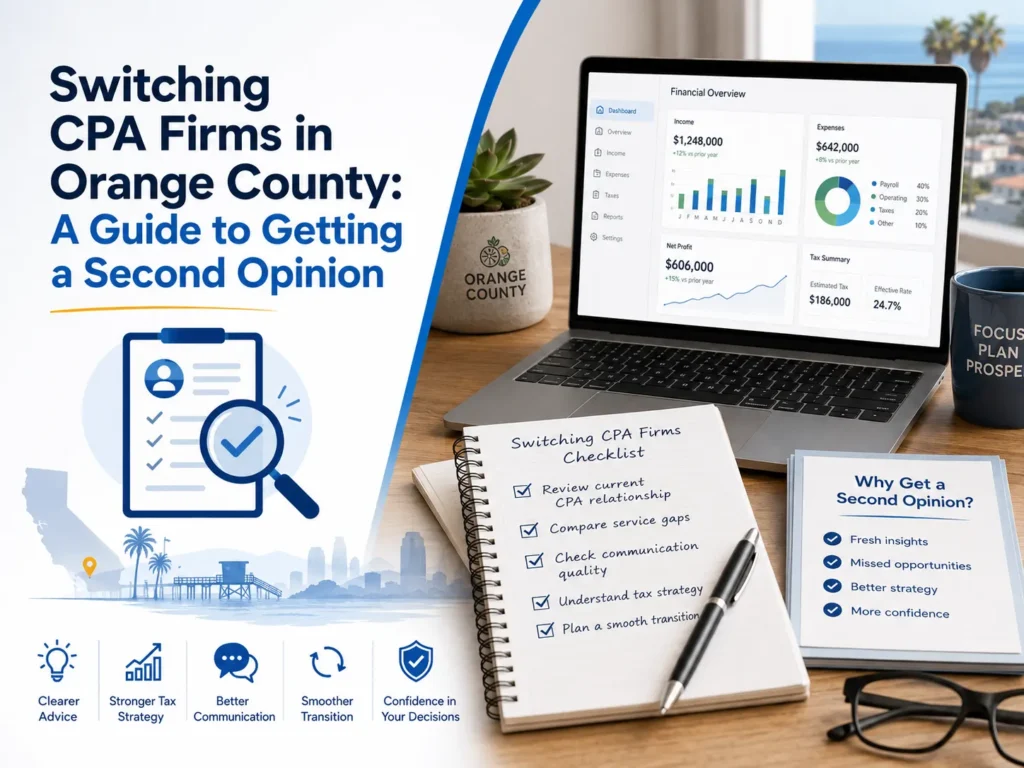
Switching CPA firms in Orange County is complicated when tax issues, deadlines, or poor communication are already causing problems. Before making a change, as a business owner, you can benefit from getting a second opinion from another CPA to determine whether the issue is a mistake, a strategy gap, or an ongoing service problem.
This guide explains when to get a CPA second opinion, when it makes sense to switch firms, and how to transition without disrupting your tax filings or IRS and California FTB matters. You’ll also learn what documents to prepare, what to compare, and what to look for in a new Orange County CPA firm.
Key Takeaways
|
When Should a Business Owner Get a Second Opinion From Another CPA Instead of Immediately Switching Firms?
A business owner should request a second opinion tax review in California when the concern is a matter of professional judgment rather than a clear mistake. Judgment questions do not always mean the current CPA is wrong, but they deserve an outside review before anyone commits to changing CPA firms in California.
Use a Second Opinion When the Problem Is a Question of Judgment, Not Necessarily a CPA Error
A second opinion is appropriate when the numbers are technically correct, but the strategy behind them is unclear. Common examples include:
- Whether the business’s entity or tax structure still fits its current size and income
- Whether tax-planning opportunities are being considered before year-end, not just at filing time
- Whether unusually large tax liabilities are reasonable given the business’s actual activity
- Whether owner compensation and distributions are being handled in a way that limits payroll tax exposure
- Whether the business receives proactive planning throughout the year or only compliance work each spring
- Whether the current CPA explains recommendations clearly enough for the owner to make an informed decision
Switch Firms When The Second Opinion Exposes A Recurring Service Or Risk Problem
Recurring issues point toward a service problem that a second opinion alone will not fix. These include repeated missed deadlines, unexplained adjustments on financial statements, poor communication, unresolved IRS or FTB notices, no tax planning outside of filing season, incomplete financial reporting, an unclear scope of services, and an inability to explain significant tax positions when asked directly.
A single disagreement between CPAs does not automatically prove the first CPA was wrong. The second CPA should be able to point to the specific rule, assumption, calculation method, or missing fact that explains why the numbers differ. If the second CPA cannot do that, the disagreement is not yet resolved, and it is too early to act on it.

When Should You Get a Second Opinion From Another CPA?
A second opinion from another CPA can help you determine whether you’re facing a genuine tax or accounting error, a difference in professional judgment, or a broader service problem. The right time to seek one is usually before a costly decision such as filing a major return, responding to an audit, or buying or selling a business.
Before Filing Major Tax Returns
A pre-filing review catches structural issues while there is still time to fix them. Reviewing a draft return before it is filed, rather than after, gives a second CPA room to flag missed deductions, entity mismatches, or unsupported positions before they become permanent on a filed return.
During an IRS or State Audit
An audit is the highest-stakes moment to bring in outside eyes. A second opinion during an active examination should confirm what has already been submitted to the examiner, what remains outstanding, and whether the current representation strategy still makes sense given the direction the audit is taking.
Before Buying or Selling a Business
Transaction due diligence surfaces problems a routine annual filing never would. A second CPA reviewing historical returns and financial statements ahead of a sale, acquisition, or major financing event often finds structuring issues, unreported liabilities, or missed elections that affect the deal price.
Signs Your Current CPA May Be Costing You Money
These are some of the clearest signs your business needs a CPA review, whether that means a second opinion or a full transition.
- Paying more taxes than necessary. No mention of entity election changes, retirement plan contributions, or accelerated depreciation strategies across multiple tax years.
- Limited strategic advice. Conversations happen only at filing time, never mid-year when planning decisions still matter.
- No year-round tax planning. The relationship is transactional: documents in, return out, no discussion of what changes for next year.
- Vague answers to direct questions. The CPA cannot explain, in plain terms, why a specific number appears on the return.
- Slow or inconsistent communication. Emails and calls go unanswered for days during non-peak season.
- Reactive handling of notices. IRS or FTB correspondence is unaddressed until the business owner escalates it personally.
These patterns are also among the common accounting mistakes California businesses should avoid repeating with a new provider, so it helps to document exactly which of these apply before starting a search.
What a Second Opinion CPA Review Includes
A second opinion tax review in California typically covers four core areas, each aimed at confirming whether the current filings and structure hold up under closer inspection.
Review of Business Tax Returns
The reviewing CPA checks the last two to three years of filed returns for consistency, correct entity treatment, and reasonable expense categorization relative to the business’s industry and revenue.
Entity Structure Evaluation
This step tests whether the current entity type, S corporation, C corporation, partnership, or LLC, still produces the best tax outcome given the business’s current income level and ownership structure.
Financial Statement Review
The CPA compares the general ledger and financial statements against the filed returns to confirm the numbers on the tax return actually reconcile to the business’s books.
Identification of Missed Deductions and Credits
The review flags deductions and credits, such as depreciation elections, retirement plan contributions, or state credits, that were available but not claimed on prior filings.
What Documents Should a Business Owner Gather for a CPA Second Opinion?
A business owner should bring a specific document package to a second opinion review. The table below breaks the package into two categories: standard compliance records and unresolved matters that directly affect the strategy the new CPA will recommend.
| Category | What to Include |
| Core tax and accounting records | Recent federal and California business tax returns, K-1s and related schedules, financial statements, general ledger or trial balance, depreciation and fixed-asset schedules, prior-year workpapers available to the business, notices from the IRS or FTB, estimated tax and payment history, current-year bookkeeping reports, prior tax-planning correspondence, and the existing engagement letter |
| Unresolved matters | Pending IRS correspondence, FTB notices, open audits or examinations, unpaid balances, proposed adjustments, amended-return discussions, and elections or filings still awaiting action |
The reviewing CPA needs to know what is already in motion with the IRS or FTB before recommending any change. A second opinion that ignores an open notice or unresolved balance is incomplete, no matter how thorough the return review looks otherwise.
How to Switch CPA Firms Without Stress
Changing CPA firms in California follows a predictable sequence once the decision is made. A smooth transition starts with gathering your records, confirming outstanding deadlines, formally notifying your current CPA, and transferring authorizations and files to the new firm.
- Gather your financial records: Pull the same document package used for the second opinion review: filed returns, financial statements, general ledger, and any open correspondence with tax agencies.
- Notify your existing CPA professionally: A short written notice, sent by email, stating the effective date of the change and requesting a file transfer keeps the relationship professional and avoids delays in receiving records.
- Transfer tax and accounting files: Request digital copies of tax returns, workpapers, depreciation schedules, and QuickBooks or accounting software backups directly, rather than waiting for the new firm to request them separately.
California FTB Authorization Is A Separate Transition Step
Federal authorization changes do not update California records automatically. For California business entities, the FTB process is that businesses can submit a power of attorney through MyFTB, and the current business-entity POA form is FTB 3520-BE, Business Entity or Group Nonresident Power of Attorney Declaration.
The FTB also draws a clear line between a POA, which permits representation, and a Tax Information Authorization, which generally permits access to information but does not authorize the representative to act on the taxpayer’s behalf.
What Happens to the Business’s IRS and California FTB Authorizations When It Changes CPA Firms?
Federal and California authorizations do not update together. A business changing CPA firms must handle each agency separately, or the old CPA may retain access long after the engagement ends.
Federal Authorization and California Authorization Should Be Checked Separately
On the federal side, the relevant tools are IRS Form 2848, Power of Attorney and Declaration of Representative, which authorizes an eligible individual to represent the taxpayer before the IRS and receive confidential tax information, and Form 8821, where the business only needs the new CPA to receive information rather than represent it.
To remove the prior CPA’s access, the taxpayer must write “REVOKE” across the top of the form and sign and date it following the instructions for Form 2848 or Form 8821. The IRS also allows representatives to view and manage active authorizations directly through Tax Pro Account.
On the California side, the FTB grants a POA Declaration limited online account access by default, and the business or its tax professional must separately request and authorize full online account access before the FTB will grant it. A new FTB 3520-BE filing does not automatically cancel a prior representative’s access if that representative covers overlapping tax years or matters, which is why confirming the prior authorization was properly revoked matters as much as filing the new one.
How Should a Business Owner Handle a CPA Change During Tax Season, an IRS Audit, or an FTB Matter?
A CPA change during a live filing deadline, audit, or FTB matter needs a different sequence than a routine transition, because a gap in representation at the wrong moment can cost the business money.
Before A Major Filing Deadline
Before switching firms close to a deadline, confirm five things in writing with both firms: who is responsible for completing the return, what work is already finished, the extension and payment deadlines that apply, access to the working files, and the new firm’s scope for the current filing year.
During an IRS Examination Or State Tax Dispute
A CPA change mid-audit should never create a gap in representation. The new CPA should first determine what notice was received, what tax period is under examination, what has already been submitted to the examiner, what deadlines remain open, and what the previous CPA already represented to the agency on the business’s behalf.
If an earlier audit already resulted in an assessment the business disagrees with, the IRS allows a request for audit reconsideration when the taxpayer has new information about the audit, never appeared for the original audit, or moved and never received the audit report, as outlined in Publication 3598. This also applies if the business receives ongoing IRS correspondence unrelated to an audit.
If you receive an IRS certified letter, such as IRS Letter 4464C, which signals the IRS is verifying a filed return before releasing a refund, the new CPA should confirm the letter type before responding, since the required response differs by letter.
How Should a Business Compare the Old CPA Firm With the New CPA Firm After the Second Opinion?
The right CPA firm should provide proactive planning, responsive communication, and reliable support when issues arise. Compare the old and new firms across tax compliance, expertise, communication, service scope, and overall value to determine whether switching will genuinely improve your business’s financial support.
The table below lists the criteria worth scoring for each firm, since a side-by-side comparison surfaces gaps a single conversation often misses.
| Comparison Criteria | What to Evaluate |
| Tax compliance reliability | On-time filings, accuracy across prior years |
| Proactive tax planning | Mid-year strategy sessions versus filing-only contact |
| Response time | Days to answer routine questions |
| Quality of explanations | Ability to explain positions in plain language |
| Industry knowledge | Familiarity with the business’s specific sector |
| State and local tax capability | Experience with California-specific rules |
| Audit and notice representation | Direct experience handling IRS and FTB matters |
| Financial reporting quality | Accuracy and timeliness of statements |
| Technology and workflow | Software compatibility, portal access |
| Continuity of personnel | Same team year over year versus high turnover |
| Clarity of engagement scope | Written, specific scope versus vague language |
| Total cost relative to services | Value delivered, not just the invoice total |
| Issue identification before deadlines | History of catching problems early |
A local CPA or a national accounting platform each has trade-offs, but a firm with direct California and Orange County experience typically has a stronger grasp of state-specific rules like the FTB’s authorization process and the $800 minimum franchise tax that applies to most LLCs and corporations.
What Should a Business Owner Demand From the New CPA Firm Before Signing the Engagement Letter?
Every new engagement should start with the scope in writing, not a verbal understanding. This is part of what to look for in a CPA firm before any documents change hands.
Get The Scope Of The New Engagement In Writing
Confirm in the written engagement letter which returns are included, whether bookkeeping is included or billed separately, whether tax planning is part of the base fee or a separate service, whether IRS and FTB representation is included, what financial statement services are covered, whether payroll support is part of the scope, how estimated taxes are handled, what response times to expect, who the responsible CPA or team member is, what the fee structure looks like, and whether any work is outsourced.
The California Board of Accountancy’s consumer guidance specifically identifies the scope of work, who will perform it, whether work is outsourced, client responsibilities, cost of services, and when the work will be completed as the items every engagement letter should cover.
What Is the Safest Way for an Orange County Business to Decide Whether to Stay With Its Current CPA or Switch?
Review the second-opinion findings, service quality, communication, and unresolved tax issues to determine whether your current CPA can address the problems or whether switching firms is the better long-term choice.
Stay If The Second Opinion Confirms The Work And The Service Issues Are Fixable
If the numbers hold up and the problems are limited to communication or scope, staying and renegotiating is often the faster fix. That can mean renegotiating scope, setting clear communication expectations in writing, adding scheduled tax-planning meetings, or requesting a different team member within the same firm.
Switch If The Review Identifies Material, Recurring, Or Unresolved Problems
Switching makes sense when the second opinion turns up unexplained tax exposure, a pattern of missed deadlines, unresolved government correspondence, thin documentation, or a consistent mismatch between what was promised and what was delivered. The safest approach is a second-opinion-first transition, not a switch driven only by a lower quoted fee from another firm.
CPA Firm Switching Checklist for an Orange County Business Owner
Before switching
- Review the current engagement letter
- Identify unfinished work
- List all open federal and state matters
- Gather recent returns and financial records
- Obtain a second opinion
- Compare findings against the current firm’s work
- Confirm the new firm’s scope and fees in writing
During transition
- Confirm who is responsible for upcoming deadlines
- Transfer records to the new firm
- Update IRS authorization (Form 2848 or 8821)
- Update FTB authorization (Form 3520-BE or FTB 3534)
- Document all open notices and audits
- Confirm the new engagement in writing before work begins
After transition
- Confirm government correspondence now reaches the new representative
- Confirm upcoming filing and payment dates
- Resolve any outstanding handoff questions
- Keep copies of all transition documentation
Benefits of Working With the Right Orange County CPA Firm
- Fewer surprises at filing time, since planning happens throughout the year instead of only in the spring
- Faster response to IRS and FTB notices, which limits penalties and interest
- A tax structure that keeps pace with the business as revenue and ownership change
- Clear, documented answers to every significant tax position taken on a return
- One point of contact who understands the business’s industry and history
- Reduced risk of the common accounting mistakes California businesses should avoid, such as missed estimated payments or unclaimed deductions
Why Orange County Businesses Choose Focus CPA
Focus CPA Group has worked with Orange County small business owners for more than two decades, offering professional accounting services for California small businesses that go beyond return preparation. As a business CPA Orange County owners can reach directly, we blend technical tax knowledge with the kind of ongoing communication that a second opinion often reveals is missing elsewhere.
- Direct experience across a wide range of small business industries, not a generic one-size-fits-all approach
- Tax preparation, tax planning, and tax resolution handled under one roof, including IRS and FTB representation
- CFO-level advisory support alongside standard compliance work
- A track record of managing entity structuring, bookkeeping, and financial consulting for growing businesses
If you are weighing a second opinion tax review in California or you have already decided to switch, we can review your prior returns, evaluate your entity structure, and give you a clear, documented answer before you sign anything new. Schedule a consultation.
Conclusion
A business owner who wants to switch CPA firms in Orange County-wide should confirm the second opinion identifies a specific rule, calculation, or missing fact behind any disagreement, then use that finding to decide whether the fix is renegotiation or a full transition.
Focus CPA Group evaluates entity structure, prior filings, and outstanding IRS or FTB matters before recommending any change, so the decision is based on documented findings.
We handle the full transition, from authorization updates to engagement letter review, so nothing falls through the gap between firms. Contact Focus CPA Group today to schedule a second opinion consultation.
FAQs
Switch when a second opinion finds recurring problems such as missed deadlines, unresolved notices, or unexplained tax positions, not after a single disagreement.
Yes. A second opinion identifies whether an issue is a judgment call or an actual error before you commit to changing CPA firms in California.
Yes, but confirm who is responsible for the current filing, what work is complete, and the applicable deadlines before the transition takes effect.
Most firms release records once notified in writing, though response time varies. Request digital copies directly rather than waiting.
A straightforward transition outside of tax season typically takes two to four weeks, depending on how quickly records and authorizations transfer.
Provide recent tax returns, financial statements, general ledger, depreciation schedules, and any open IRS or FTB notices.
Yes. A new CPA can file amended returns once they identify errors, subject to the IRS and FTB's applicable statute of limitations for each tax year.
Look for a written engagement letter with clear scope, direct industry experience, and a documented process for handling IRS and FTB correspondence.
Cost varies by firm and by how many tax years are under review. Ask for a fixed quote before the review begins.
Focus CPA Group reviews prior filings, evaluates entity structure, and manages the full transition, including federal and California authorization updates.
