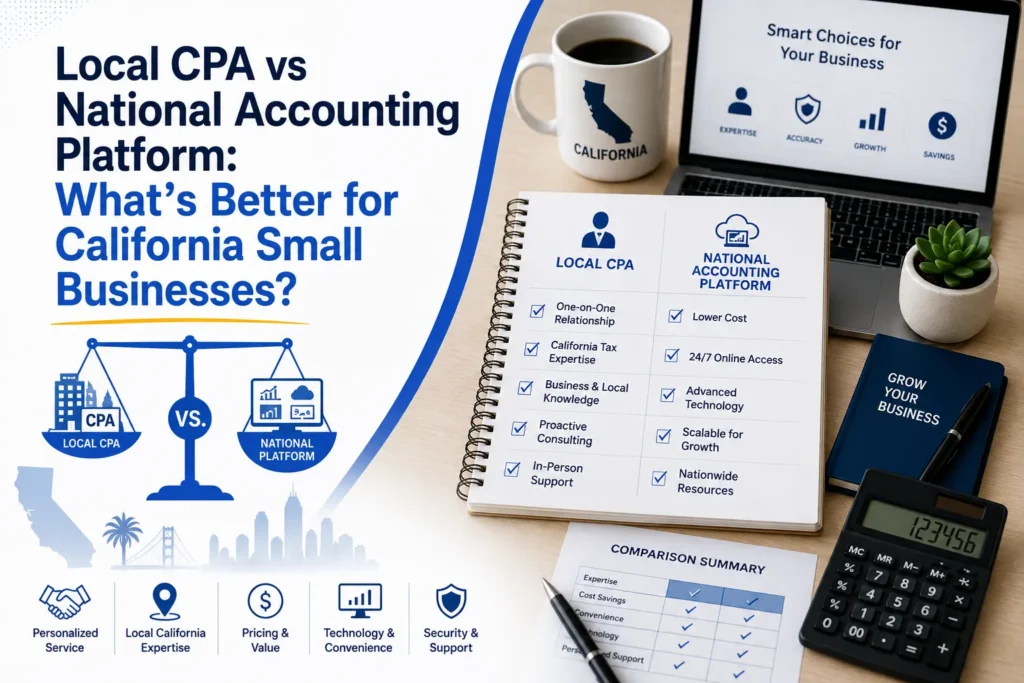
A local CPA vs national accounting firm decision comes down to whether your business needs California-specific tax expertise or just basic bookkeeping done cheaply. While national platforms often appeal with predictable, lower-cost subscription tiers, they frequently lack the granular, California-specific tax expertise that is essential for navigating the state’s complex compliance landscape. For most small business accounting services California owners search for, the answer favors a local CPA once revenue crosses six figures or a tax notice arrives.
With 99.9% of California businesses falling under the ‘small business’ classification, understanding the real-world impact of state-specific tax laws is critical to your long-term growth and compliance.
Key Takeaways
|
Understanding the Difference Between Local CPAs and National Accounting Platforms
A local CPA vs national accounting firm comparison starts with structure. One is a licensed individual working in your city. The other is a tech platform matching you with remote staff who may never have touched a California return before yours.
What Is a Local CPA Firm?
A local CPA firm is a licensed accounting practice, usually with a handful of accountants, based in your state or county. A local CPA in California holds a state-issued license, meaning they passed the CPA exam and meet ongoing education rules set by the California Board of Accountancy.
Local firms build long-term files on your business, tracking entity type, prior filings, and risk points before a problem shows up.
What Is a National Accounting Platform?
A national accounting platform is a subscription service, like 1-800Accountant, pairing clients with accountants through an app rather than in person, built for scale, not one state’s rules. This app-first model is why so many owners search for a 1-800Accountant alternative after their first tax question gets a generic answer.
These platforms run on flat-rate tiers, starting near $179 to $209 a month, billed annually, pushing the first-year total to $2,148 to $5,028 depending on the tier.
Which Option Fits Small Businesses Best?
It depends on complexity, not size. A national vs local accountant choice matters less for a single-member LLC with simple books. A business with employees or multiple revenue streams usually needs small business accounting services. California owners can build California small business tax planning around every quarter.

Benefits of Working with a Local CPA in California
The biggest benefit of a local CPA California relationship is direct accountability. You aren’t routed to a new representative every few months, and your accountant already understands state filing traps before they cost you money.
Personalized Financial and Tax Advice
Personalized advice means your CPA builds a plan around your actual numbers, not a template. This is where CPA vs accountant vs bookkeeper confusion causes problems. A bookkeeper enters transactions, which covers basic bookkeeping tasks in QuickBooks. A CPA interprets those numbers and advises on structure, timing, and deductions, which is the core of real California CPA services.
Knowledge of California Tax Laws and Compliance
California runs some of the strictest state tax rules in the country, including a 13.3% top marginal income tax rate, the highest of any state. Anyone who plans to hire a CPA in California should confirm they track these changes as law, not as a once-a-year checklist item.
- The $800 minimum franchise tax applies to every active LLC, LP, and corporation, per FTB Revenue and Taxation Code Section 17941.
- LLCs earning above $250,000 in total income owe an added LLC fee, up to $11,790.
- S corporations pay the greater of $800 or 1.5% of net income.
- Missed FTB payments carry a 5% penalty plus 0.5% added interest monthly.
| Example: a Sacramento LLC formed in late 2024 assumed the first-year exemption still applied. It didn’t, since that rule expired January 1, 2024. A local CPA catches changes like this before they become penalties. |
Easier Communication and Faster Response Times
Faster response comes from proximity and smaller client loads. A local CPA California firm typically responds within one business day, since they aren’t managing thousands of accounts through a national ticket queue.
Advantages of National Accounting Platforms
National platforms make sense for standardized, software-driven bookkeeping without much complexity. Their biggest strength is predictable, published pricing, which matters in any national vs local accountant comparison.
Technology and Automation
Automation means transaction categorization and bank syncing happen through software. Platforms like 1-800Accountant use a system called ClientBooks to produce standard reports automatically.
Standardized Pricing Models
Standardized pricing means every client on the same tier pays the same rate, with no hourly surprises. This kind of outsourcing accounting services for small business owners works fine for a simple, single-state business with few monthly transactions.
When National Platforms Make Sense
National platforms fit early-stage businesses needing basic filing and nothing else. A freelancer with one income stream and a simple national vs local accountant need may not yet need deep, ongoing support.
Comparing Local CPA Firms vs National Accounting Platforms
A direct national vs local accountant comparison shows the gap widens as revenue grows. The table below compares the four factors that matter most for small business accounting services California owners.
| Factor | Local CPA Firm | National Platform |
| Pricing | Custom, based on scope | Flat annual tiers, $2,148 to $5,028+ |
| State tax expertise | California-specific, ongoing | General, multi-state focused |
| Response time | Same-day to next-day | Ticket queue, variable |
| Audit support | In-person representation | Limited to plan tier |
The table above shows pricing looks cheaper upfront with a platform, but the value gap shows up once an IRS or FTB letter arrives.
Pricing and Overall Value
A local CPA’s fee reflects actual work, often $150 to $250 an hour, but costs less overall once missed deductions get factored in. National accounting for small businesses is broader and should weigh total cost, not the sticker price alone.
Tax Planning and Business Strategy
Tax planning adjusts decisions before year-end to reduce what you owe. Filing is reactive. Real California small business tax planning happens months ahead, not the week before a deadline.
Industry-Specific Expertise
A CPA who has worked with 30 restaurants catches margin pressure a generalist platform accountant won’t flag, shortening the learning curve on field-specific deductions.
Scalability for Growing Businesses
Scalability means the relationship grows with added complexity, like payroll or multiple entities. Missed quarterly payments and mixed personal expenses are common signs your business has outgrown DIY accounting, which show up faster than owners expect.
Why California Small Businesses Often Choose Local CPA Firms
California small businesses often choose local firms because state compliance carries real financial risk that generic national support doesn’t always catch. This is the core case for local CPA vs national accounting firm buyers weighing both sides.
- A local firm flags the LLC fee threshold before a business crosses $250,000 and owes an unexpected fee.
- Local CPAs track California’s 30/40/0/30 estimated tax schedule, different from the federal equal-quarter system.
- A California CPA services provider catches entity-specific deadlines, like the March 16 date for S corporations versus April 15 for LLCs.
A Fresno agriculture business used a national platform for two years and missed its LLC fee entirely, since the default workflow assumed a simpler entity type. Anyone planning to hire a CPA in California should confirm entity classification gets reviewed yearly.
When a National Platform May Not Be Enough
A national platform often falls short once a business faces an audit, adds employees, or needs multi-year tax resolution. Public BBB records for platforms like 1-800Accountant show hundreds of complaints tied to billing disputes and delayed responses.
- Businesses needing IRS or FTB audit representation often need in-person document review, not a ticketing system.
- Payroll compliance across California’s overtime and paid sick leave rules needs local labor law familiarity.
- Converting an LLC to an S corp needs custom paperwork that basic outsourcing accounting services for small business tiers may not cover.
If your business needs a 1-800Accountant alternative because of missed deadlines or a locked annual contract, that’s the signal to look for professional accounting services for small businesses with a dedicated, local point of contact instead of another flat-tier platform running the same script.
Why Focus CPA Is the Right Choice for California Businesses
Focus CPA Group has spent more than two decades working with California business owners, and we understand the state’s compliance risks because we handle them weekly, not once a year. We were named 2022 Best of Brea for Tax Consulting.
- We assign every client a dedicated CPA who tracks filings, deadlines, and entity status year-round, offering small business accounting services California owners can rely on without switching contacts.
- We provide bookkeeping services for small business owners who need clean books without hiring in-house staff.
- We combine tax preparation with CFO-level strategy, including fractional and virtual CFO support, and clear bookkeeping in QuickBooks guidance so you know what you’re paying for.
- We handle IRS and FTB notices directly, with representation built into every client relationship, giving clients 1-800Accountant alternative support without an annual lock-in.
Customized Accounting Solutions for Business Growth
We scale support as your business adds employees or revenue streams, from basic bookkeeping services for small business owners to full CFO-level oversight. If you’re ready for accounting built around your business instead of a fixed tier, book a consultation with us today.
Choosing the Right Accounting Partner for Long-Term Success
The local CPA vs national accounting firm decision hinges on how much California-specific risk your business carries. A local CPA in California catches franchise tax deadlines, LLC fee thresholds, and entity rules that national platforms are built to miss.
At Focus CPA Group, we help you avoid FTB penalties and plan strategy months in advance instead of scrambling every April. Contact us today to work with a team that treats your business like more than an account number.
FAQs
Yes, for California-specific compliance. A local CPA in California catches franchise tax and LLC fee issues that national platforms, built for 50 states, often miss.
In the local CPA vs national accounting firm decision, California owners lean local because the $800 minimum franchise tax and added LLC fees carry real risk that generic software often misses.
Yes. Focus CPA Group offers a dedicated 1-800Accountant alternative with year-round support and no annual lock-in contract tied to a fixed tier.
Not always. Platforms bill $2,148 to $5,028 annually upfront, which is why many owners still look for a 1-800Accountant alternative once they compare that total to a local CPA's actual scope.
Yes. Local CPAs build California small business tax planning into each quarter, adjusting strategy before deadlines instead of only filing after year-end.
In the national vs local accountant debate, a local CPA fits growing businesses better, since scaling payroll or multiple entities needs support beyond a flat tier or outsourced accounting for small businesses' default.
Yes. Local CPAs typically provide direct, in-person representation for IRS and FTB notices, while platform tiers often limit audit support to add-on fees.
Yes. Most businesses switch at year-end or after a missed deadline, and a local California CPA services provider can review prior filings before taking over.
Look for the best CPA firm in California with state-specific experience, a dedicated point of contact, and proactive planning instead of reactive, once-a-year filing.
