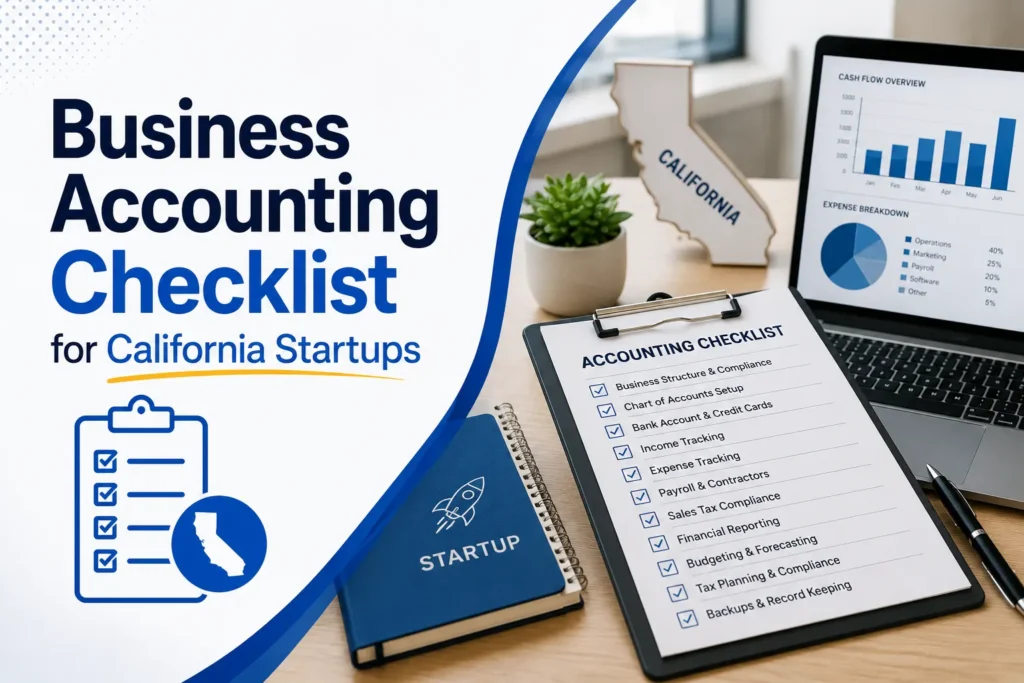
Managing finances in California needs more than just tracking expenses. With complex EDD payroll registration, franchise tax, and strict contractor rules, startups can face penalties before they even turn a profit. A business accounting checklist for startup founders that covers five things: separate bank accounts, a bookkeeping routine, quarterly tax prep, payroll compliance, and monthly financial reviews is a must-have for California businesses.
Don’t let tax deadlines or payroll compliance stall your growth. This guide simplifies the essential accounting tasks every California startup founder needs to master. Use this checklist to set up your finances correctly, stay ahead of state-mandated reporting, and keep your books ready for your next funding round.
Key Takeaways
|
Why Every California Startup Needs an Accounting System from Day One
A startup without an accounting system from day one usually finds out its cash position is wrong right when it matters most, during a funding round or a tax deadline. Clean books are not optional paperwork. They are how you know if you are actually making money.
- In our experience, founders who wait until year-end to organize records lose more time fixing errors than they would have spent tracking numbers weekly. A missed receipt in January becomes a missing deduction in April.
- Investors and lenders ask for financial statements before they ask for your pitch deck. A messy general ledger can stall a raise by weeks.
- California’s franchise tax and payroll rules move faster than most founders expect. One missed EDD deadline creates penalties before the business even turns a profit.
Step 1: Set Up Your Business Finances Properly
A new business financial setup starts with separating your money before you separate your paperwork. The order matters because everything else, from bookkeeping to taxes, depends on clean transaction data from day one.
Open a Dedicated Business Bank Account
A dedicated business bank account is a checking account used only for business income and expenses. It protects you from personal liability if your business is an LLC or corporation, since commingling funds can pierce that legal protection.
Separate Personal and Business Expenses
Separating expenses means every business purchase runs through the business account, never your personal card. This single habit is one of the most overlooked accounting tasks startup owners skip, and it is the fastest way to lose deductions.
Choose the Right Accounting Method
Cash and accrual accounting are the two methods the IRS recognizes. Cash-basis records income when you receive it and expenses when you pay them. Accrual records income when earned and expenses when incurred, even before cash moves. Most startups under $30 million in average gross receipts can choose either method, but accrual gives investors a clearer picture of financial health.
Step 2: Choose the Right Accounting Software
The right accounting software depends on your transaction volume, not brand popularity. QuickBooks Online works for most California startups because it connects directly to EDD and IRS reporting formats and scales with contractor and payroll needs.
Configure Your Chart of Accounts
A chart of accounts is the list of categories your business uses to sort every transaction, like rent, software, or payroll. Setting this up correctly before your first month of transactions saves hours of reclassification later.
Automate Expense Tracking
Automated expense tracking connects your bank feed directly to your software so transactions import daily instead of manually. QuickBooks bookkeeping support from a professional during setup prevents miscategorized expenses that snowball into messy year-end reports.
Step 3: Create a Bookkeeping Routine
A bookkeeping routine is a repeating schedule of daily, weekly, and monthly tasks that keep your books accurate. This is the core of any working monthly bookkeeping checklist.
Daily Bookkeeping Tasks
Daily tasks include recording sales, logging receipts, and categorizing new bank transactions as they post. Five minutes a day beats five hours in April.
Weekly Financial Reviews
A weekly review means checking outstanding invoices, upcoming bills, and account balances every week. This keeps cash flow visible before a shortfall becomes a crisis.
Monthly Bank Reconciliations
A bank reconciliation matches your accounting records against your actual bank statement to confirm every transaction is recorded correctly. Skipping this step is the top reason startup books drift out of sync with reality.
Step 4: Prepare for Taxes Throughout the Year
Tax preparation for startups is not a once-a-year task. It is an ongoing part of accounting tasks that startup owners handle monthly to avoid surprises and penalties.
Track Business Expenses
Every deductible expense needs a receipt, date, amount, and business purpose under IRS Publication 583 recordkeeping rules. Digital scans count as valid records as long as they are stored consistently.
Estimate Quarterly Taxes
You generally owe quarterly estimated tax if you expect to owe $1,000 or more for the year after withholding and credits. For 2026, federal payments are due April 15, June 15, September 15, and January 15, 2027. Paying 100% of last year’s tax, or 110% if your prior year adjusted gross income topped $150,000, protects you from underpayment penalties under the IRS safe harbor rule.
Maintain Digital Tax Records
The IRS requires employment tax records to be kept for at least four years. Cloud storage with automatic backups meets this standard and protects records against a lost laptop or hard drive failure.
Step 5: Manage Payroll and Contractor Payments
Payroll and contractor compliance is where California startups get penalized most often, because the state layers extra deadlines on top of federal rules. This is the heart of any real California payroll compliance checklist.
Employee Payroll Compliance
California employers must register with the EDD within 15 days of paying more than $100 in wages during a calendar quarter. Miss that window and penalties start accruing before your first payroll run is even complete.
Managing 1099 Contractors
Independent contractors paid $600 or more in a year require a Form 1099-NEC. California also requires a DE 542 report to the EDD within 20 days when the contractor is an individual, sole proprietor, or single-member LLC.
Payroll Tax Filing Requirements
California employers file quarterly wage reports (DE 9 and DE 9C) even in quarters with no wages paid. Missing a filing, not just a payment, still triggers penalties.
Step 6: Review Financial Reports Regularly
Reviewing three core financial reports monthly tells you whether your startup is actually healthy, not just busy. This is where small business bookkeeping California founders rely on most for real decision-making.
Profit and Loss Statement
A profit and loss statement shows total revenue minus total expenses over a set period, revealing whether the business made or lost money. Review this monthly, not quarterly, to catch problems while they are still small.
Cash Flow Statement
A cash flow statement tracks money moving in and out of your accounts, separate from paper profit. A business can show a profit and still run out of cash if customers pay late.
Balance Sheet Review
A balance sheet lists what your business owns, owes, and retains as equity at a specific point in time. Reviewing it monthly catches growing debt or shrinking reserves before they become a crisis.
Step 7: Build a Scalable Financial System
A scalable financial system is one that still works when your headcount, revenue, or investor reporting needs triple. Building it early costs far less than rebuilding it under pressure later.
Budgeting for Growth
A growth budget forecasts revenue and expenses against your hiring and product roadmap, not just last year’s numbers. Revisit it quarterly as actual results come in.
Preparing for Investors and Lenders
Investors expect clean, accrual-based financial statements going back at least twelve months before they fund a round. A fractional CFO or full-time CFO can prepare these faster than a founder juggling ten other roles.
How Focus CPA Helps California Startups Stay Financially Organized
Focus CPA Group has supported small businesses across California for more than two decades from its Brea office, and startups are exactly where an early accounting foundation matters most. We build the systems above into a working structure instead of a checklist you have to figure out alone.
- We handle full-cycle bookkeeping, QuickBooks setup, and monthly reconciliations so founders are not learning accounting software while also running a company.
- We provide outsourced CFO services and fractional CFO support, giving startups investor-ready reporting without a full-time executive hire.
- We build California small business tax strategies around your actual entity structure, not generic advice, and handle quarterly estimated payments so deadlines never slip.
Whether you need a CPA, accountant, or bookkeeper, we cover the full range so you are not managing three separate vendors. Book a consultation with us to build your accounting system before your first tax deadline arrives, not after.
Build Your Startup on a Strong Financial Foundation
A working business accounting checklist that startup owners can rely on includes these five habits: separate accounts, a weekly bookkeeping routine, quarterly tax payments, payroll compliance, and monthly financial reviews. Together, these turn financial management from a year-end scramble into a system that supports funding rounds, tax deadlines, and daily decisions without surprises.
Focus CPA Group turns that system into daily practice instead of theory. We combine startup bookkeeping and accounting services California founders need with CPA-level tax planning so your books stay audit-ready and your tax strategy stays ahead of deadlines rather than reacting to them.
Contact Focus CPA Group today to set up an accounting system that scales as fast as your startup does.
FAQs
A dedicated bank account, monthly bookkeeping, quarterly tax payments, payroll setup, and monthly financial statement review.
Before the first payroll run or investor conversation, whichever comes first, to avoid EDD penalties and reporting errors.
QuickBooks Online, because it integrates directly with payroll, contractor 1099 filing, and most CPA firm reporting tools.
Daily for transactions, weekly for cash flow, and monthly for full reconciliation against bank statements.
Yes. Monthly profit and loss, cash flow, and balance sheet reviews catch problems while they are still fixable.
Receipts, invoices, bank statements, and payroll records must be kept at least four years under IRS employment tax rules.
Yes, always. Mixing funds risks personal liability protection and makes deductions harder to prove during an audit.
We manage bookkeeping, payroll compliance, and tax strategy together, so founders get one accountable team instead of three vendors.
Mixing personal and business funds, skipping quarterly taxes, and waiting until year-end to reconcile bank accounts.
