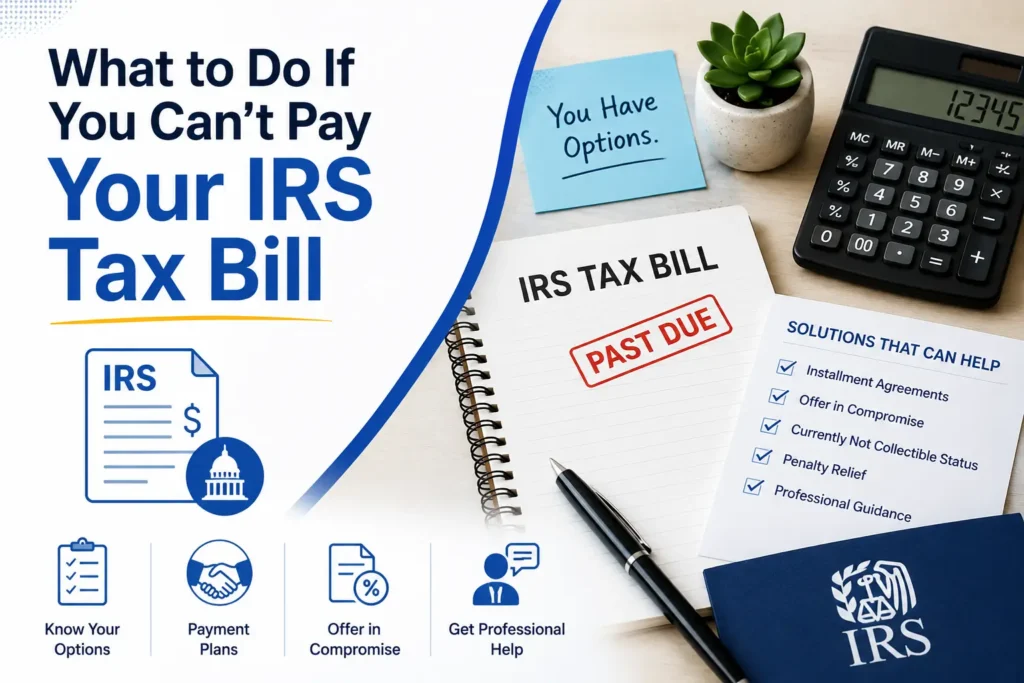
Paying tax bills can be difficult if you’re already dealing with other financial issues. If you have received a tax bill to pay and you can’t pay the IRS taxes in full, file your return anyway and pay what you can. The IRS offers several IRS payment options for taxpayers who can’t cover the full balance right away, and most people qualify without ever speaking to an agent.
Whether you’re facing an IRS tax bill you can’t afford as an individual or you’re behind on business taxes, here’s every realistic path forward. This guide breaks down the options available and how to deal with a tax bill.
Key Takeaways
|
What Happens If You Can’t Pay Your IRS Tax Bill?
Penalties and interest start building the day after your filing deadline, but nothing drastic happens overnight. The IRS sends a notice, the balance grows, and collection actions like liens or levies follow only if it’s ignored. Most people who owe the IRS and can’t pay still have time to set up a plan before things escalate.
Penalties and Interest That Continue to Accrue
The failure-to-pay penalty runs 0.5% of your unpaid balance per month, capped at 25%. Interest compounds daily at the federal short-term rate plus 3%. A $10,000 balance left unpaid for a full year could add over $1,000 in combined charges. Set up a payment plan on a timely filed return, though, and the penalty rate drops to 0.25% a month while the plan is active.
The Importance of Filing Even If You Can’t Pay
File on time regardless of what you owe. The failure-to-file penalty is 5% per month, up to 25%, ten times steeper than the failure-to-pay penalty. Miss the deadline by more than 60 days and a minimum penalty kicks in: the lesser of $525 or 100% of the tax owed for 2026 returns. Timely tax filing alone can save thousands compared with filing late and paying late.

IRS Payment Options Available to Taxpayers
Most taxpayers qualify for a plan through the IRS Online Payment Agreement tool without ever calling an agent. The two main IRS payment options are a short-term extension and a long-term installment agreement, and which one fits depends on your balance and how fast you can pay it off.
The table below shows how balance size determines your repayment window and fees.
| Plan Type | Balance Limit | Time to Pay | Setup Fee |
| Short-Term Payment Plan | Under $100,000 | Up to 180 days | None |
| Long-Term Installment Agreement | Under $50,000 | Up to 10 years | Often waived for low-income taxpayers |
Short-Term Payment Extension
A short-term plan gives you up to 180 days to pay a balance under $100,000 in combined tax, penalties, and interest, with no setup fee. It works well if you’re close to clearing the debt and don’t want a formal monthly commitment. Approval through your IRS Online Account is often instant.
Long-Term Installment Agreement
A long-term agreement, or Simple Payment Plan, lets you pay a balance under $50,000 monthly across the collection statute, generally 10 years. IRS payment plan rules allow this through Form 9465 or the online portal, and most individual filers qualify automatically below that threshold. Interest and reduced penalties continue during the agreement, but staying current keeps liens and levies off the table.
Paying by Direct Debit or Other Payment Methods
Direct debit installment agreements pull payments automatically, lowering your setup fee and nearly eliminating default risk. Low-income taxpayers who choose direct debit often get the fee waived entirely. Other accepted methods include IRS Direct Pay, debit or credit card, EFTPS for businesses, and the IRS2Go app; paper checks are being phased out as the IRS moves to electronic-only processing through 2026.
What If You Can’t Afford Monthly Payments?
If even a reduced monthly payment would break your budget, the IRS offers two paths: settling for less than you owe, or pausing collections until your finances improve. Both require documented proof of income, expenses, and assets.
Offer in Compromise (OIC)
An IRS Offer in Compromise settles your tax debt for less than the full balance, based on your Reasonable Collection Potential, the most the IRS could realistically collect from your assets and future income. You apply with Form 656 plus Form 433-A (OIC) for individuals or 433-B (OIC) for businesses and a $205 fee unless you qualify for Low-Income Certification.
In FY 2024, the IRS received about 49,000 OIC applications and accepted roughly 16,500, close to a 34% acceptance rate. Accepted offers settled an average $16,000 debt for $6,629, a 59% reduction. You must have filed every required return and made current-year estimated payments; skip either, and your offer gets rejected before review.
One strategy we use often: filing shortly after a documented income drop, like a layoff, since the IRS calculates your offer using current income, not last year’s earnings.
Currently Not Collectible (CNC) Status
CNC status means the IRS agrees that paying anything now would prevent you from covering basic living expenses, so it pauses active collection. Penalties and interest still accrue, and the IRS can still file a Notice of Federal Tax Lien even while your account sits in CNC. The IRS reviews your finances periodically, and collection resumes once your income improves. It’s a pause button, not a fix, but it buys real breathing room.
Financial Hardship Relief Options
- Request a temporary collection delay by calling the number on your notice
- Apply for First-Time Abate if you’ve had three clean compliance years
- File Form 8857 for innocent spouse relief on a joint-return debt
- Ask about reinstating a payment plan that previously defaulted
How the IRS Determines Your Payment Eligibility
Eligibility rests on your balance size, filing history, and documented financial condition, not on what you say you can afford. Every option, from a short-term extension to an IRS Offer in Compromise, runs through the same financial review.
- Total balance owed sets which plans you qualify for automatically
- Filed returns determine whether you’re eligible to apply at all
- Income-to-expense ratio, measured against IRS Collection Financial Standards, drives OIC and CNC decisions
- Asset equity, including retirement accounts at 80% of fair market value, factors into your collection potential
Required IRS Forms and Documentation
Form 433-A covers individuals and self-employed taxpayers; Form 433-B covers businesses. Both list income, expenses, assets, and debts. Form 9465 requests an installment agreement, and Form 656 starts the OIC process alongside its matching financial statement. Have pay stubs, bank statements, and monthly expenses ready before applying; missing paperwork is the top reason applications stall.
Common Mistakes to Avoid When You Owe the IRS
Silence is the biggest mistake. Taxpayers who ignore notices lose the chance to negotiate before liens or wage garnishment start. IRS compliance strategies always begin with responding to that first letter, even without an answer yet.
- Skipping your return because you can’t pay, triggering the steeper failure-to-file penalty
- Assuming you don’t qualify for a plan without checking the actual balance thresholds
- Missing current-year estimated payments during an OIC review, which voids the offer
- Not prioritizing filing business taxes correctly before payroll tax debt becomes personal liability
Borrowing Money Without Comparing IRS Options
Taking a high-interest loan or maxing a card to pay the IRS often costs more than the IRS’s own penalty and interest combined. Compare the loan’s APR against the current failure-to-pay rate first; a home equity loan might beat it, but a cash advance rarely does. We’ve seen clients drain savings to pay in full, only to hit a real crisis months later. A payment plan usually protects your cash flow better.
When Should You Work With a Tax Professional?
Bring in a professional once your balance crosses $10,000, spans multiple tax years, or involves a business entity. A tax debt attorney or CPA should also step in the moment the IRS mentions a lien, levy, or wage garnishment, since professionals negotiate directly with agents and avoid costly disclosure mistakes.
Choosing the Right Resolution Strategy
Steady income with a large balance usually fits a long-term installment agreement; reduced income with few assets often qualifies for an Offer in Compromise or CNC status instead. A qualified preparer runs your collection potential before filing anything.
How Focus CPA Group Helps Resolve IRS Tax Problems
Focus CPA Group has spent more than two decades helping California taxpayers and small business owners through IRS tax resolution services, from back taxes to full collection defense. We negotiate directly with the IRS, so you’re not the one explaining your finances to a revenue officer.
- We evaluate your full financial picture before recommending a plan, an Offer in Compromise, or CNC status
- We prepare Forms 433-A, 433-B, 656, and 9465 accurately the first time to avoid rejection delays
- We handle penalty abatement, innocent spouse relief, and wage garnishment removal
- We represent you in audits and collection disputes, so you’re never facing the IRS alone
If you’re staring at an IRS tax bill you can’t afford, book a consultation, and we’ll map your options before your next notice arrives.
We set up short-term and long-term agreements matched to your real cash flow, filed the first time correctly to avoid back-and-forth delays. We run your Reasonable Collection Potential before filing, so you know your realistic settlement range before paying the application fee.
IRS Hardship & Collection Defense
When a lien, levy, or garnishment is already in motion, we negotiate a release or delay while your resolution case moves forward, with direct access to the professional handling your file.
Take Action Before IRS Collections Become More Serious
A tax bill you can’t pay in full today doesn’t have to become a lien, levy, or wage garnishment tomorrow. Filing on time, choosing the right IRS payment options, and responding to every notice keep you in control of the outcome. Whether that means a short-term extension, an installment agreement, or an IRS Offer in Compromise, the path forward depends on acting before the balance grows and options narrow.
Focus CPA Group has guided California taxpayers through this exact process for more than 20 years, filing accurate financial statements the first time and negotiating directly with the IRS on your behalf. We know which resolution program fits which financial situation because we’ve built the case files that got offers accepted and liens released.
We’ll review your notice, your full financial picture, and your realistic options in one conversation, then build a strategy around your numbers. Contact us before your next IRS deadline passes.
FAQs
File your return by the deadline, pay what you can, then apply for a short-term or long-term payment plan through your IRS Online Account within days.
Yes. Most individual taxpayers with a balance under $50,000 qualify for a long-term installment agreement paid monthly over up to 10 years.
Penalties and interest start accruing immediately, but the IRS won't pursue liens or levies right away if you file on time and request a payment arrangement.
It settles your tax debt for less than the full amount owed, based on your Reasonable Collection Potential; roughly 34% of applications were accepted in FY 2024.
Taxpayers who prove that paying anything would prevent covering basic living expenses qualify, though penalties and interest keep accruing during this status.
No, but the failure-to-pay penalty drops from 0.5% to 0.25% per month once a payment plan is active and your return was filed on time.
Yes. Ignoring notices and skipping payment arrangements can lead to wage garnishment, bank levies, or a federal tax lien on your property.
Yes. A CPA or enrolled agent can file Form 2848 to represent you directly, handling all communication and negotiation with IRS agents.
Seek help once your balance exceeds $10,000, spans multiple tax years, involves a business, or the IRS mentions a lien or levy.
