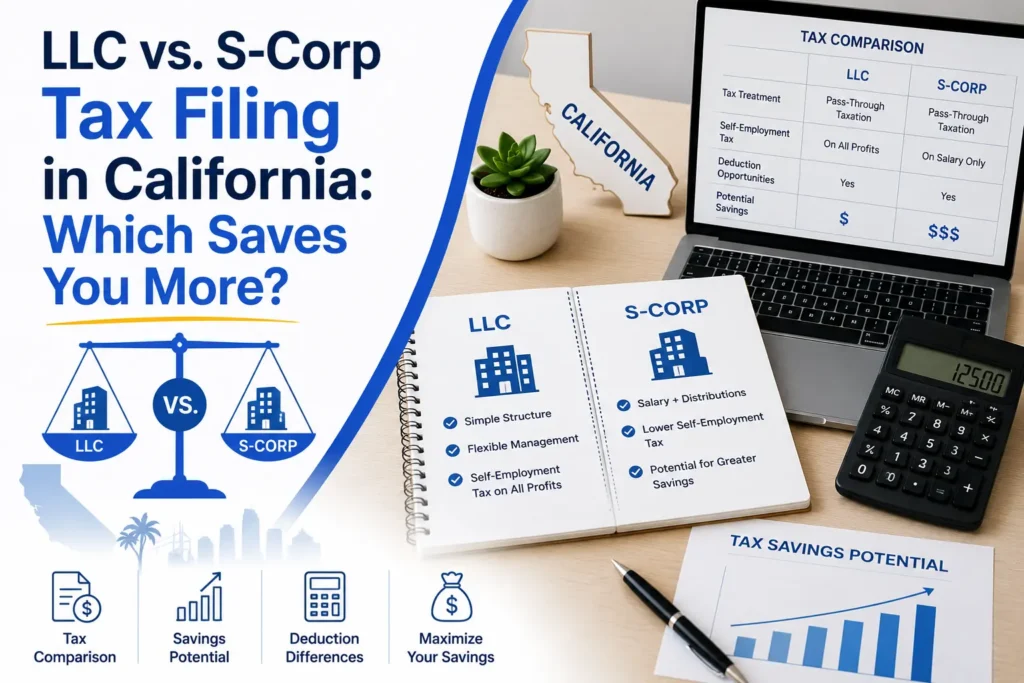
An S-Corp usually beats an LLC on taxes once your net profit passes roughly $40,000 to $50,000 a year, because it cuts your self-employment tax bill. Below that level, a plain LLC costs less to run and keeps your paperwork simple.
The choice between these two structures changes how much of your income goes to Social Security and Medicare taxes and what you pay California every year. This guide breaks down LLC vs. S-Corp tax California rules using current IRS and Franchise Tax Board guidance so you can choose between an LLC and an S-Corp with actual numbers.
Key Takeaways
|
Understanding LLC vs S-Corp Taxation in California
An LLC and an S-Corp are taxed in completely different ways, even though both protect your personal assets. The LLC is a legal structure, while S-Corp is a tax election you layer on top of an LLC or corporation.
How LLCs Are Taxed by Default
A single-member LLC is taxed as a disregarded entity by default, meaning all profit flows straight to your personal Form 1040 on Schedule C. A multi-member LLC is taxed as a partnership and files Form 1065, with each owner reporting their share on Schedule K-1. In both cases, according to IRS Publication 3402, the owner pays self-employment tax on the full net profit, not just a portion of it.
How S-Corp Taxation Works
An S-Corp is not a separate legal entity type. It is a tax status your LLC or corporation elects using IRS Form 2553. Once elected, the business must pay the owner a reasonable W-2 salary through payroll, and only that salary is subject to self-employment-style payroll taxes. Remaining profit passes through as a distribution, which skips Social Security and Medicare tax entirely.
Key Tax Differences Between an LLC and an S-Corp
The biggest gap between these two structures comes down to how self-employment tax applies and how California charges its franchise tax. Both rules directly change your take-home pay every year.
Self-Employment Tax Differences
Self-employment tax runs 15.3% on net profit, split between 12.4% for Social Security on the first $184,500 of income in 2026 and 2.9% for Medicare with no cap. An LLC owner pays this tax on the entire net profit. An S-Corp election in California limits it to the salary portion only, which is where most of the savings come from.
Salary vs Distribution Rules
The IRS requires an S-Corp owner to take a reasonable salary before taking any distributions, based on what the job would pay someone else. Paying yourself too little to dodge payroll tax is a common audit trigger.
The table below compares how a $120,000 net profit business is taxed under each structure.
| Item | LLC (Default) | LLC Taxed as S-Corp |
| Subject to self-employment tax | Full $120,000 | Salary only, for example $65,000 |
| Distribution, free of SE tax | $0 | $55,000 |
| Approximate SE/payroll tax | $18,360 | $9,945 |
| California franchise tax | $800 | Greater of $800 or 1.5% of net income |
The table above shows that shifting $55,000 into distributions removes roughly $8,400 from the self-employment tax bill before accounting for payroll processing costs.
California Franchise Tax and Annual Fees
Every LLC doing business in California owes the $800 annual franchise tax, and since January 1, 2024, there is no first-year waiver for LLCs. An S-Corp pays the greater of $800 or 1.5% of net income, per the California Franchise Tax Board, plus an LLC gross receipts fee if the LLC’s own California income tops $250,000.
When an LLC Makes More Financial Sense
An LLC makes more sense financially when your net profit is still under roughly $40,000 to $50,000, because the payroll and accounting costs of an S-Corp would eat up any tax savings. Simplicity wins at this stage.
Lower Administrative Requirements
An LLC files one return, either Schedule C or Form 1065, and does not require payroll, W-2s, or a separate corporate tax return. There is no reasonable salary test to satisfy or defend in an audit.
Flexible Ownership and Profit Distribution
LLC members can split profits in whatever ratio the operating agreement allows, regardless of ownership percentage. An S-Corp must distribute profit strictly according to ownership share, which removes that flexibility.
Best for New or Lower-Profit Businesses
A freelance graphic designer earning $35,000 a year would pay roughly $4,900 in self-employment tax as an LLC. Electing S-Corp status here would add payroll software, quarterly filings, and a separate California return, often costing more than it saves. This is the exact case where entity structure tax savings favor staying simple.
When an S-Corp Can Save You More Money
An S-Corp saves more money once your business consistently clears around $50,000 to $60,000 in net profit, since the self-employment tax saved on distributions outweighs payroll and filing costs.
Reducing Self-Employment Taxes
Every dollar shifted from salary to distribution above the reasonable compensation line skips the 15.3% self-employment tax rate. This is the single largest lever in LLC taxed as S-Corp savings calculations.
Profit Thresholds Where S-Corp Pays Off
A consultant with $150,000 in net profit paying themselves a $75,000 reasonable salary would save around $10,600 a year in self-employment and payroll taxes compared to staying an LLC, based on 2026 Social Security wage base figures.
Common Businesses That Benefit Most
- Consultants and coaches with steady, predictable income
- Real estate agents earning consistent commission income
- Medical and dental practices with one or two owner-operators
- E-commerce sellers with profit margins above 20%
A local bookkeeping firm we’ve seen move from LLC to S-Corp status at $85,000 in net profit typically recovers the added payroll cost within the first two quarters.
Cost and Compliance Comparison
An S-Corp costs more to run than an LLC because it adds payroll, a separate tax return, and stricter recordkeeping. Those added costs typically range from $1,500 to $3,000 a year.
Payroll Requirements
S-Corp owners must run formal payroll, withhold federal and state payroll taxes, and file quarterly reports under IRS Publication 15, Circular E. An LLC owner has none of these obligations.
Tax Return Filing Requirements
An S-Corp files Form 1120-S federally and Form 100S with the California Franchise Tax Board, both due March 15 for calendar-year filers. A single-member LLC typically only needs a personal return, while a multi-member LLC files Form 568 with California.
Ongoing Bookkeeping and Recordkeeping
S-Corps need separate books that track salary, distributions, and shareholder basis accurately, since mixing these figures up can trigger IRS scrutiny. This is one reason firms that offer professional accounting services for California small businesses insist on clean, month-by-month records.
How to Elect S-Corp Status for Your LLC
You elect S-Corp status by filing IRS Form 2553 within 2 months and 15 days of the date you want the election to start, or any time during the prior tax year.
IRS Form 2553 Requirements
Form 2553 requires your EIN, chosen tax year, and signed consent from every owner. For a calendar-year business wanting S-Corp status for 2026, the deadline was March 16, 2026, since March 15 fell on a Sunday.
California Filing Considerations
California automatically recognizes a federal S-Corp election. There is no separate state-level S-Corp election form, but you must still file Form 100S instead of Form 568 once the federal election is active.
Common Election Mistakes to Avoid
- Missing the 2-month-and-15-day filing window
- Forgetting a shareholder’s signature, which voids the whole election
- Electing S-Corp status before profit justifies the added cost
- Paying an unreasonably low salary once elected
Mistakes Business Owners Make When Choosing an Entity
Most business owners pick a structure based on what a friend used instead of running their own numbers first. This is one of the most common mistakes when setting up a business in California.
- Electing S-Corp status too early, before profit covers the added payroll cost
- Ignoring the $800 California franchise tax when comparing structures
- Paying themselves an unreasonably low S-Corp salary that invites an audit
- Never revisiting the structure again after revenue grows
- Skipping tax planning strategies for small businesses that combine entity choice with deductions
How Focus CPA Helps California Businesses Choose the Right Entity
Focus CPA Group helps California business owners pick between an LLC and an S-Corp using real profit projections, not guesswork. We run the actual numbers for your business before recommending any change.
Entity Selection Based on Your Business Goals
We look at your net profit, ownership structure, and growth plans before recommending an entity. Our team explains the tax benefits of incorporating your small business in California in plain terms, so you understand exactly why a structure fits your situation.
We build a California business tax structure plan around your numbers, timing your S-Corp election to meet IRS deadlines and modeling a reasonable salary against your actual profit.
Ongoing Compliance and Accounting Support
Our team manages your payroll setup, Form 1120-S or Form 568 filing, and Franchise Tax Board deadlines all year, not just at tax time. To reduce taxes with expert tax planning, you need a firm watching these dates continuously.
Work with a firm that offers real California small business tax deductions analysis alongside entity guidance; book a consultation with us today.
Selecting the Right Tax Structure for Long-Term Savings
The right choice between an LLC and an S-Corp comes down to one number: your net profit. Below $40,000 to $50,000, an LLC’s simplicity wins. Above that range, an S-Corp election in California typically saves thousands in self-employment tax once payroll costs are covered.
Focus CPA Group is the right choice because we build a projection using your real numbers, then handle every filing, deadline, and payroll detail that comes with the structure you choose.
We help you time your S-Corp election correctly, set up compliant payroll, and file every required form with California and the IRS so nothing slips through the cracks. Our team stays with you as your profit grows and your best structure changes. Contact Focus CPA Group today to schedule your consultation.
FAQs
An S-Corp is usually better once net profit passes about $40,000 to $50,000, since it cuts self-employment tax on distributions.
Elect once net profit is consistent and high enough that self-employment tax savings exceed added payroll and filing costs, typically above $50,000.
Savings often range from $5,000 to $15,000 a year on profits between $100,000 and $200,000, depending on your reasonable salary.
Yes. California automatically follows your federal S-Corp election, but you must file Form 100S instead of Form 568 afterward.
S-Corp owners must run formal payroll, pay themselves a reasonable salary, and file quarterly payroll tax reports under IRS Publication 15.
Yes. Only your salary is subject to payroll tax; remaining profit taken as a distribution skips the 15.3% self-employment tax.
S-Corps must file Form 1120-S federally, Form 100S with California, run payroll, and track shareholder basis separately from LLC bookkeeping.
Yes. File Form 2553 within 2 months and 15 days of the tax year you want the election to start.
Yes. A CPA runs your actual profit numbers to confirm whether entity structure tax savings justify the added S-Corp cost.
